Workplace Culture: The Conditions That Shape Performance
Aug 03, 2026
Workplace culture is not defined by the values displayed on an office wall. It is shaped by the conditions employees encounter every day, including how work is organized, how leaders behave, what the organization rewards, and what it allows to continue.
By César Gamio, Founder and Managing Director · 10-minute read
Key takeaways
- Workplace culture is created through repeated experiences, decisions, and leadership behaviors, not simply through stated values.
- Workload, fairness, trust, psychological safety, accountability, and work design influence both employee behavior and organizational performance.
- Organizations need to assess the conditions shaping their culture before launching another communication campaign, values exercise, or isolated training initiative.
Culture is often discussed more than it is understood
When organizations decide that their culture needs to change, they often begin with visible activities.
They refresh their values, organize workshops, launch an internal communications campaign, introduce new leadership language, or ask employees to commit to a set of desired behaviors.
These initiatives can create useful discussion, but they do not necessarily change what employees experience.
An organization may describe itself as collaborative while teams compete for information and resources. It may promote openness while employees learn that challenging a senior leader carries personal risk. It may claim that wellbeing matters while unmanageable workloads remain normal. It may emphasize accountability while influential people are allowed to behave in ways that others cannot.
The formal message and the lived reality begin to separate.
When that happens, employees usually trust the reality.
Culture is not what an organization says it values. Culture is what employees repeatedly experience, observe, and learn to expect.
This is why workplace culture cannot be transformed through language alone. Values may describe an aspiration, but systems, decisions, leadership behavior, and workplace conditions determine whether that aspiration becomes credible.
Workplace culture is an operating environment
Culture is sometimes treated as a collection of attitudes or personalities, as though the organization simply needs more positive, engaged, or collaborative people.
That interpretation places too much responsibility on the individual and too little on the environment.
Employees do not arrive at work and independently choose how much trust, openness, cooperation, or accountability will exist. Their behavior develops within a system of expectations, incentives, risks, and consequences.
People learn whether it is safe to admit uncertainty. They learn whether raising a concern leads to curiosity or blame. They learn whether strong performance creates opportunity or simply additional workload. They learn whether leaders follow the standards they expect from everyone else.
Over time, these experiences create shared assumptions about how the organization really works.
Gallup describes a strong culture as one that becomes visible through employee experience, behavior, work practices, systems, policies, and processes. This reinforces an important point: culture becomes real when it is embedded in how work operates, not when it remains a statement of intent. Explore Gallup’s guidance on building a performance-oriented workplace culture.
Culture is the operating environment that teaches people which behaviors are useful, which are risky, and which are rewarded.
The conditions that shape workplace culture
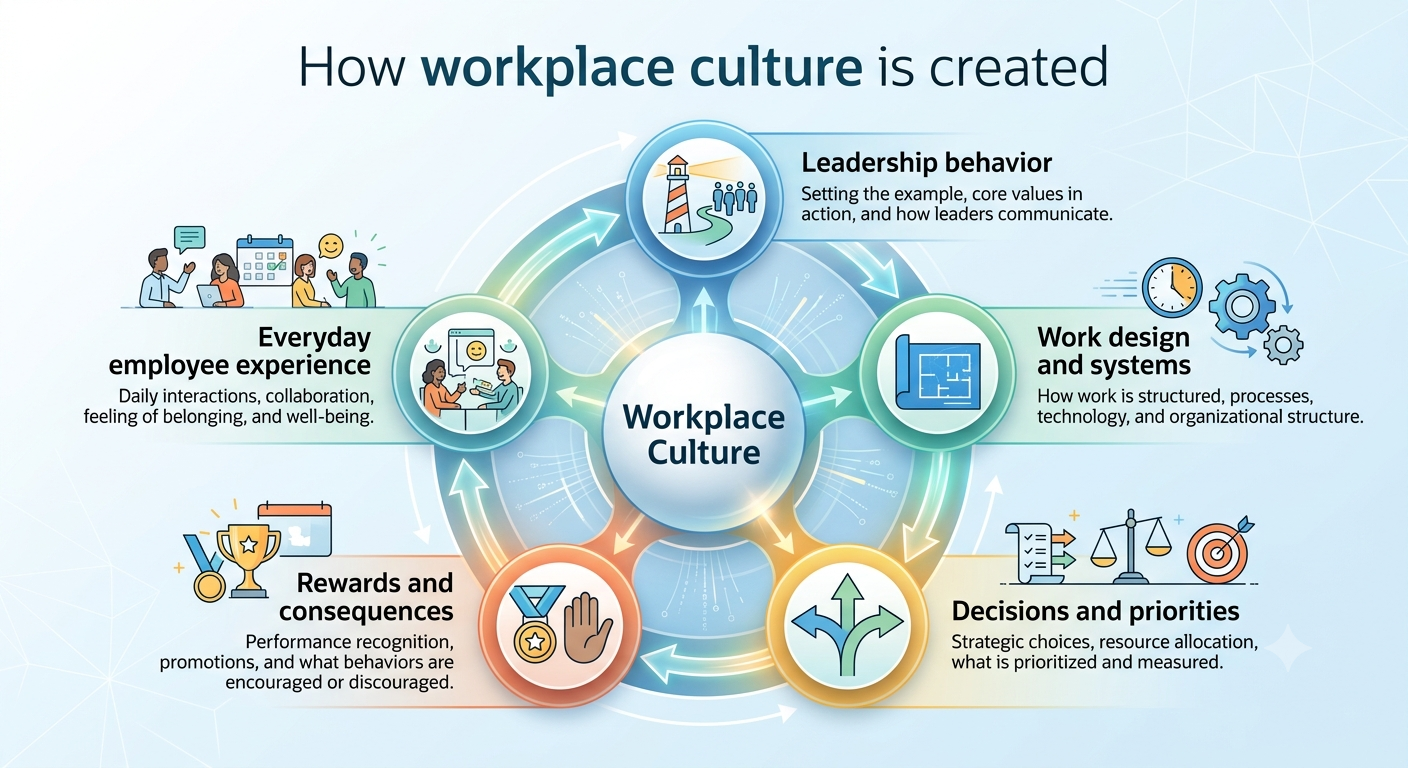
Every organization has its own history, structure, and business pressures, but several workplace conditions consistently influence how culture develops.
Leadership behavior
Employees pay close attention to what leaders do when circumstances become difficult.
Values are easy to support when there is little tension between people, performance, and commercial priorities. Culture becomes more visible when leaders face pressure, disagreement, poor results, or significant change.
Do leaders communicate honestly, or do they withhold information until rumors fill the gap?
Do they invite challenge, or become defensive when their decisions are questioned?
Do they address harmful behavior from high performers, or protect them because their commercial contribution is considered too valuable?
Do they admit mistakes, or allow responsibility to travel downward?
These moments teach employees more about culture than any leadership presentation.
Managers are particularly influential because they translate organizational priorities into daily employee experience. Gallup reports that managers account for 70 percent of the variation in team-level engagement, which demonstrates how strongly local leadership affects whether people feel clear, supported, valued, and connected to their work. Read Gallup’s research on managers, engagement, and business performance.
Organizations cannot separate culture from manager capability. When managers lack the confidence or skills to handle workload, conflict, feedback, performance, change, and employee concerns, the consequences become part of the culture.
Workload and work design
Culture is also shaped by how work is designed.
An organization may encourage collaboration, but employees will struggle to cooperate if their workloads leave no time to support one another. It may promote innovation, but people will avoid experimentation if every mistake is punished. It may value quality, but employees will make compromises when resources and deadlines make quality impossible.
Work design sends a continuous message about what the organization genuinely prioritizes.
The UK Health and Safety Executive identifies demands, control, support, relationships, role, and change as six areas of work design that can contribute to work-related stress when they are not managed effectively. These same areas influence culture because they shape how employees experience pressure, autonomy, clarity, support, relationships, and organizational change. Review the HSE Management Standards for work-related stress.
When employees are consistently overloaded, uncertainty and self-protection become more likely. People become less patient, less generous with information, and less willing to take on responsibilities outside their immediate role.
The result may be described as a communication problem or a lack of teamwork, even though the deeper cause lies in staffing, workload, unclear priorities, or unrealistic expectations.
Trust and psychological safety
Trust develops when employees see consistency between what leaders say and what they do.
It grows when decisions are explained, commitments are honored, concerns are taken seriously, and standards apply across levels of seniority.
It weakens when communication is selective, commitments disappear, mistakes are used against people, or leaders respond defensively to challenge.
Psychological safety is closely connected to trust, but it has a specific organizational importance. It affects whether employees feel able to raise concerns, ask questions, acknowledge mistakes, contribute ideas, and disagree responsibly.
A culture in which employees remain silent may appear calm, but silence is not evidence of trust.
People may be withholding information because they have learned that speaking carries too much risk. When this happens, leaders receive a filtered version of organizational reality, while problems continue to develop outside their view.
A quiet workplace is not necessarily a healthy workplace. Sometimes it is a workplace in which employees have stopped believing that honesty will help.
Fairness and consistency
Employees constantly assess whether organizational decisions are fair.
They compare how workloads are allocated, how opportunities are offered, how flexibility is approved, how performance is recognized, and how misconduct is handled.
Not every decision will satisfy everyone, and fairness does not mean treating every employee identically. It does mean that decisions should have a credible rationale and that standards should be applied consistently.
When employees perceive that influence matters more than contribution, or that certain individuals operate under different rules, trust declines.
This can create a culture in which employees focus on protecting their position rather than contributing openly. Political awareness becomes more valuable than collaboration, and employees learn that relationships with power may matter more than performance or integrity.
Accountability
Healthy cultures do not remove accountability. They make it clearer and more constructive.
In weak accountability cultures, problems may be ignored until they become serious, expectations may vary from one manager to another, and difficult conversations may be repeatedly postponed.
In punitive cultures, accountability becomes associated with blame, humiliation, or fear.
Neither approach supports sustainable performance.
Effective accountability requires clear expectations, timely feedback, fair consequences, appropriate support, and the confidence to address issues before frustration spreads through the team.
When leaders tolerate behavior that contradicts stated values, they make a cultural decision. Employees observe that decision and adjust their own expectations accordingly.
Communication and organizational change
Communication is often identified as a cultural problem, but the issue is rarely solved by simply sending more messages.
Employees need communication that provides context, clarity, and relevance. They need to understand what is changing, why it matters, how decisions were made, what remains uncertain, and what is expected from them.
This is particularly important during restructuring, technology implementation, strategic change, or leadership transition.
Poorly managed change can create confusion, cynicism, and fatigue. Employees may begin to believe that each new initiative will disappear before it is fully implemented, which reduces willingness to invest energy in future programs.
Culture change therefore requires more than launching a new message. It requires leaders to manage the employee experience of change with consistency and credibility.
Why values initiatives often fail
Values are not inherently ineffective. They become ineffective when organizations expect them to overcome contradictory systems and behavior.
A company may introduce a value such as “people first,” but employees will not believe it if workload concerns are dismissed.
It may promote “courage,” but employees will not demonstrate courage if challenging a decision damages their career.
It may promote “collaboration,” but collaboration will remain difficult if incentives reward individual competition.
It may emphasize “integrity,” but that value will lose meaning if leaders avoid difficult decisions when commercial interests are involved.
Employees do not reject values because they are cynical by nature. They become cynical when the gap between language and experience remains too wide.
Values become credible when employees can see them influencing decisions, priorities, leadership behavior, and consequences.
A values workshop can begin a conversation, but it cannot complete a culture transformation. The organization must translate each value into observable behaviors, leadership expectations, management practices, and operational decisions.
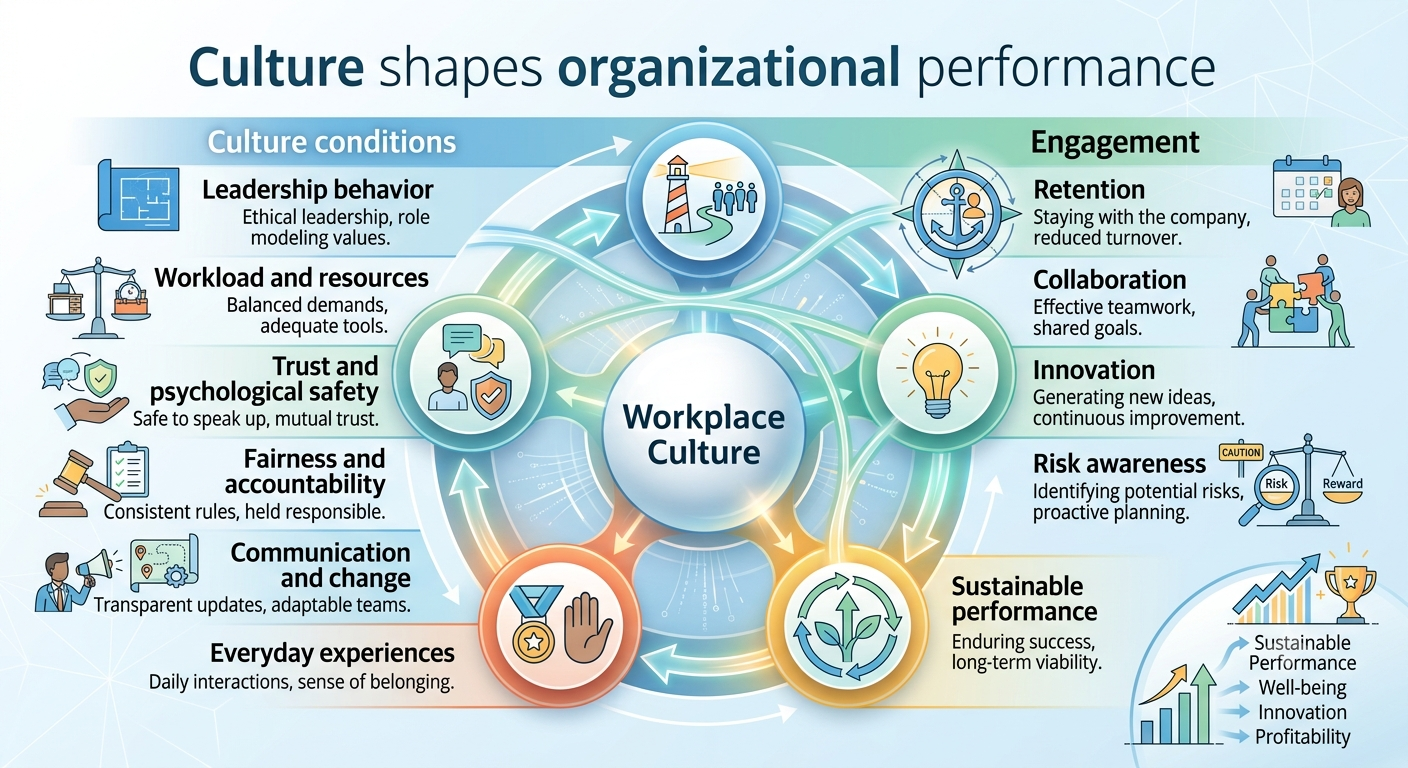
Culture and performance are inseparable
Workplace culture is sometimes treated as a soft issue that sits alongside the serious work of strategy, operations, and performance.
In reality, culture influences how effectively strategy and operations are executed.
It affects whether people share information, challenge weak decisions, take responsibility, cooperate across functions, adapt to change, and remain committed during pressure.
Gallup’s engagement research consistently connects clarity, purpose, development, recognition, and manager support with stronger employee engagement. Gallup also reports that engaged employees and teams produce better business outcomes across industries and organizational contexts. Explore Gallup’s guidance on the drivers of employee engagement.
A high-performance culture should not be confused with a high-pressure culture.
High-pressure cultures may produce impressive short-term output, especially when employees are motivated, professionally committed, or fearful of failure. However, if performance depends on chronic overwork, silence, internal competition, or inconsistent leadership, the model becomes difficult to sustain.
A healthier performance culture creates clarity, accountability, appropriate challenge, trust, and the conditions people need to deliver consistently.
Culture cannot be separated from mental health and safety
Workplace culture also influences psychological health.
The World Health Organization’s guidance on mental health at work recommends organizational interventions that directly address working conditions and environments, alongside manager training, worker training, and appropriate individual support.
This is important because culture determines whether employees feel supported when they experience difficulty, whether excessive pressure is normalized, whether harmful behavior is addressed, and whether concerns are treated as useful information.
ISO 45003 provides organizations with guidance for managing psychological health and safety risks within an occupational health and safety management system. It applies to organizations of different sizes and sectors and emphasizes the importance of identifying and managing workplace conditions that can contribute to harm. Learn more about ISO 45003 from the International Organization for Standardization.
A culture that protects mental health is not one that avoids challenge or difficult decisions. It is one that manages demands responsibly, treats people fairly, supports appropriate employee voice, and addresses harmful conditions before they become accepted as normal.
Why employee surveys are not enough
Many organizations assess culture through an annual engagement or employee survey.
Surveys can provide valuable information, but they do not change culture on their own.
The quality of the questions matters, as does the credibility of the process. Employees need to understand why information is being collected, how confidentiality will be protected, and what leaders will do with the results.
The greatest risk arises when organizations ask for honest feedback and then fail to respond.
Employees may initially interpret the survey as an opportunity to influence change. When the results produce little visible action, future participation can become more cautious or cynical.
Survey scores may remain acceptable even while trust in the process declines.
Assessment must therefore be connected to dialogue, prioritization, ownership, and action. Leaders should communicate what they heard, which issues will be addressed first, who is responsible, and when employees can expect progress.
They should also be honest about what cannot change immediately.
Employees do not expect every issue to be solved at once, but they do expect their feedback to be treated seriously.
Culture change should begin with diagnosis
Organizations often begin culture change by defining the culture they want.
That is useful, but it is only half of the work.
They also need to understand the culture they currently have.
This requires evidence about how employees experience leadership, workload, trust, communication, fairness, psychological safety, role clarity, accountability, and change.
Without diagnosis, leaders may invest in the most visible issue rather than the most influential one. They may respond to low engagement with recognition initiatives when the deeper problem is workload. They may introduce communication training when employees are actually withholding information because they fear the consequences of speaking.
A structured Workplace and Culture Assessment helps leaders distinguish between symptoms and underlying conditions.
It can reveal patterns across teams, levels, functions, and locations, while identifying where the organization’s stated values align with employee experience and where significant gaps remain.
From cultural aspiration to everyday practice
Culture change becomes credible when the organization translates aspiration into everyday practice.
That may involve:
- Clarifying the leadership behaviors expected at every level
- Reviewing workload, staffing, and decision-making processes
- Improving the quality of manager conversations
- Strengthening psychological safety and employee voice
- Addressing inconsistent accountability
- Explaining decisions more transparently
- Aligning recognition and promotion with desired behavior
- Supporting employees through organizational change
- Measuring progress and adapting the approach
Culture is reinforced through repetition. Employees need to see that new expectations continue after the launch event, survive changes in leadership, and influence difficult decisions.
This is why culture transformation requires ownership beyond HR. It must involve senior leadership, managers, operations, and the functions that shape work systems, resources, incentives, and risk.
Strong cultures make good work possible
A strong workplace culture does not mean that employees agree on everything, avoid pressure, or feel positive every day.
It means that the organization creates conditions in which people can contribute honestly, understand what is expected, use their judgment, learn from mistakes, and trust that standards will be applied fairly.
It means that leaders address difficult issues rather than allowing them to become normalized.
It means that performance is supported by clarity, capability, and sustainable work design rather than by chronic pressure or individual sacrifice.
Organizations that want to improve culture should therefore ask more than:
“What values do we want employees to demonstrate?”
They should also ask:
“What are our systems, decisions, and leadership behaviors currently teaching employees about how this organization really works?”
The answer to that question is often the clearest description of the culture the organization already has.
Understand the conditions shaping your workplace culture
Dharma’s Workplace and Culture Assessments help organizations understand how employees experience leadership, workload, trust, psychological safety, communication, fairness, wellbeing, and performance.
The assessment provides leaders with evidence about the conditions shaping workplace culture and helps identify where focused action can make the greatest organizational difference.