Why Good Employees Leave: The Role of Workplace Conditions
Aug 03, 2026
Good employees rarely leave because of one isolated event. Workload, leadership behavior, trust, fairness, and work design often shape the decision long before a resignation is submitted.
By César Gamio, Founder and Managing Director · 10-minute read
Key takeaways
- Salary and career opportunities may trigger a resignation, but workplace conditions often create the underlying desire to leave.
- Workload, manager behavior, autonomy, fairness, psychological safety, and role clarity all influence whether good employees remain committed.
- Organizations need to understand the conditions behind turnover while there is still time to act, rather than relying only on exit interviews after employees have decided to leave.
A resignation is rarely the beginning of the story
When a strong employee resigns, organizations often search for a simple explanation. They may assume that the employee received a better salary, wanted greater flexibility, was approached by a competitor, or had reached a natural point in their career.
Any of these explanations may be accurate, but they rarely tell the whole story.
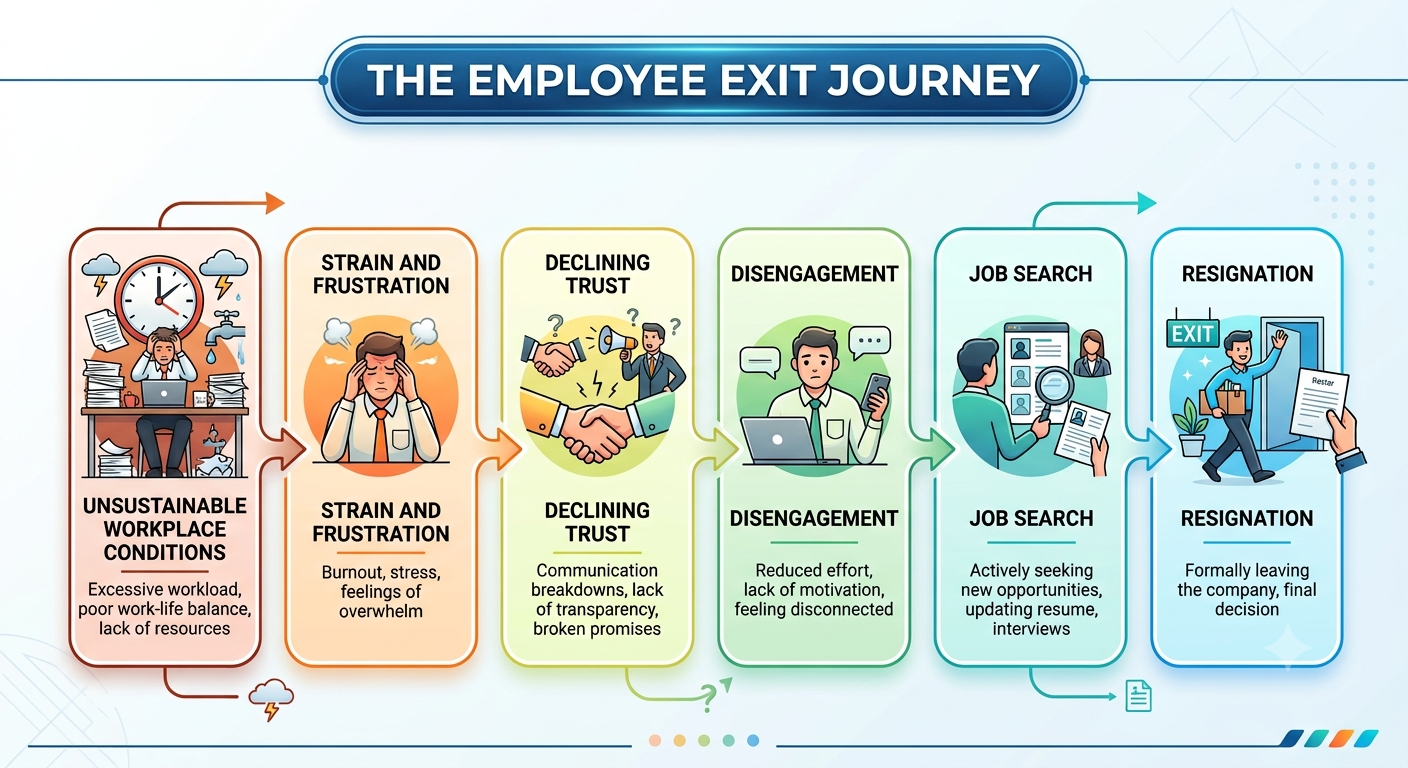
Good employees seldom leave because of one difficult week or a single disappointing conversation. More often, resignation is the final outcome of workplace conditions that have gradually become frustrating, unfair, or unsustainable. What appears sudden to the organization may have been developing for months.
The employee may have tried to manage an excessive workload, asked for greater clarity, raised concerns with a manager, waited for a promised development opportunity, or adapted repeatedly to changing priorities. They may have continued producing excellent work throughout that period, which can make the risk of departure difficult for leaders to recognize.
Strong performance can conceal growing dissatisfaction and an increasing intention to leave.
Gallup reports that 42 percent of employees who voluntarily left their organization believed that their manager or employer could have done something to prevent their departure. Its research also found that 36 percent of voluntary leavers did not speak to anyone before deciding to resign. These findings do not suggest that every resignation can or should be prevented, but they do indicate that many departures are influenced by workplace experiences that an organization has some ability to change. Read Gallup’s research on preventable employee turnover.
The more useful question is therefore not simply, “Why did this employee leave?”
It is:
“What did this employee repeatedly experience that made leaving feel like the better option?”
Employees experience the workplace, not the employer brand
Organizations often invest heavily in communicating their values, benefits, flexibility, career opportunities, and commitment to wellbeing. These messages may attract candidates, but they do not define the daily employee experience.
Employees experience an organization through the work itself.
They notice whether workloads are achievable, priorities are clear, managers listen, decisions appear fair, and speaking honestly creates personal risk. They also notice whether strong performance leads to recognition and development, or simply results in additional work.
These repeated experiences form the real employee value proposition.
A competitive salary may persuade someone to join, but it will not necessarily persuade them to remain in an environment where they feel unsupported, overextended, undervalued, or unable to do their best work.
This is why retention cannot be treated solely as a recruitment, compensation, or benefits issue. It is also a question of culture, leadership, work design, psychological safety, and organizational health.
An organization’s employment proposition is not defined only by what it promises. It is defined by what employees repeatedly experience.
Retention initiatives often focus on the wrong level
When turnover rises, organizations may respond by reviewing salaries, expanding benefits, improving recognition, or introducing additional wellbeing resources.
These actions can be useful, but they cannot compensate indefinitely for poor workplace conditions.
An employee cannot use a wellbeing app to resolve an unmanageable workload, and a recognition award cannot repair inconsistent leadership. Additional benefits cannot create role clarity, restore fairness, or make it safer for employees to challenge a poor decision.
The World Health Organization’s guidance on mental health at work recommends organizational interventions that address workplace risks, alongside manager training, worker training, and appropriate individual support. These organizational interventions can include changes to working conditions, communication, flexibility, and the way work is designed and managed.
The emphasis matters. Organizations should not only help employees manage pressure; they should also examine whether preventable workplace conditions are creating that pressure.
Instead of asking only, “How can we help employees cope more effectively?” leaders should also ask:
“What are we asking employees to cope with?”
That shift moves retention from the edge of the HR agenda into the center of leadership, culture, risk, and organizational performance.
The workplace conditions that push good employees away
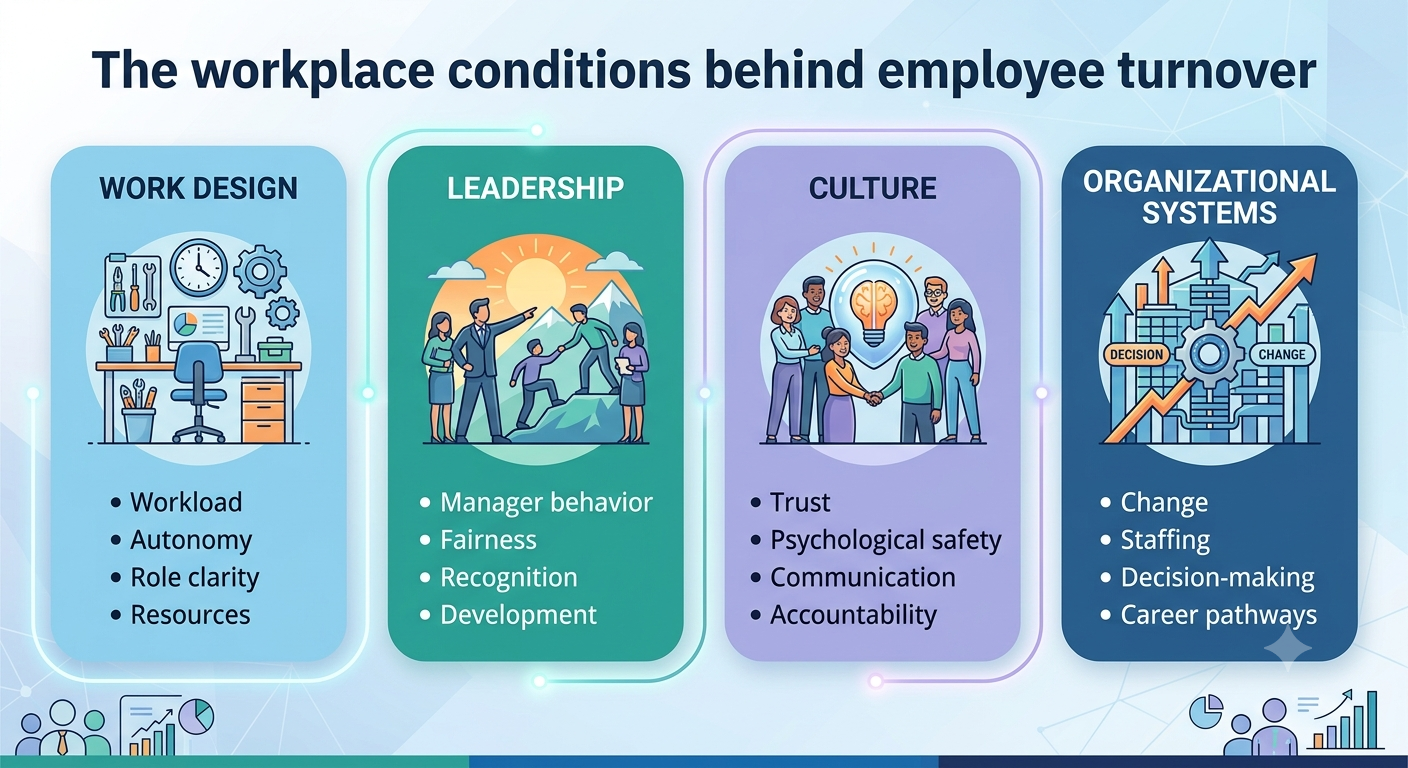
Employees leave for different reasons, but several workplace conditions repeatedly weaken commitment and increase turnover risk.
Unmanageable workload
Good employees are often given more work because they have demonstrated that they can deliver. Initially, this may feel like recognition, but over time competence can become a penalty.
Capable employees receive additional projects, resolve problems left by others, support colleagues, and absorb the consequences of understaffing. Because they continue performing, leaders may assume that the workload is manageable.
It may not be manageable at all. The employee may be compensating through longer hours, reduced recovery, emotional effort, and personal sacrifice. The quality of their work may remain high even while their relationship with the organization deteriorates.
Workload becomes a retention risk when exceptional effort stops being temporary and becomes the normal operating model. The organization may interpret continued output as resilience, while the employee sees it as evidence that good performance will always be rewarded with more pressure.
Poor management
Employees do not need perfect managers, but they do need managers who provide clarity, communicate consistently, offer support, address problems, and treat people fairly.
Managers influence much of the daily employee experience. They shape how priorities are interpreted, whether concerns are heard, how mistakes are handled, how workloads are allocated, whether conflict is addressed, and whether development conversations lead to meaningful opportunities.
Technical expertise alone does not prepare someone to manage these human dimensions of work.
For many employees, the manager becomes the organization. When that relationship repeatedly creates confusion, inconsistency, or distrust, commitment to the wider organization begins to weaken.
Organizations cannot build an effective retention strategy without strengthening manager capability.
Lack of control and autonomy
Capable employees generally want an appropriate level of influence over how their work is completed.
Micromanagement, excessive approval processes, and constant intervention can make experienced people feel distrusted. At the opposite extreme, employees may be given accountability without the authority, information, resources, or decision-making power required to deliver.
Both conditions are damaging.
The UK Health and Safety Executive identifies six areas of work design that can contribute to work-related stress when they are not managed properly: demands, control, support, relationships, role, and change. These areas are also highly relevant to retention because they influence whether employees experience work as manageable, coherent, and sustainable. Review the HSE framework for managing work-related stress.
For high-performing employees, autonomy is not simply a preference. It supports professional dignity, motivation, ownership, and the effective use of judgment.
Unfairness and inconsistency
Employees continually observe how the organization distributes opportunity, recognition, flexibility, workload, and accountability.
They notice when poor behavior is tolerated from senior or commercially valuable colleagues. They notice when promotion criteria change depending on who is being considered. They notice when dependable employees carry disproportionate workloads while underperformance remains unaddressed.
They also notice when flexibility is offered selectively without a clear rationale.
Perceived unfairness damages trust in both leadership and organizational systems. Once employees stop believing that effort, integrity, and contribution will be treated fairly, their relationship with the organization changes.
They may continue performing, but their emotional commitment often begins to decline.
Low psychological safety
Good employees frequently identify customer problems, operational risks, inefficiencies, and leadership blind spots before senior decision-makers do.
Whether they share those observations depends on the environment.
In psychologically unsafe workplaces, employees learn that challenging an idea may be interpreted as negativity, admitting uncertainty may damage credibility, and reporting a problem may result in blame.
They begin to edit themselves, which means they raise fewer concerns, contribute fewer ideas, and avoid difficult conversations. The organization can therefore lose access to their judgment long before it loses their employment.
An employee who repeatedly feels unable to speak honestly may eventually conclude that meaningful contribution is no longer possible.
Unclear roles and competing priorities
Ambiguity creates hidden strain because employees struggle when they do not understand what success looks like, who owns a decision, which priority matters most, or how their performance will be assessed.
High performers may compensate for ambiguity by working harder, creating their own systems, and absorbing coordination failures. This can make organizational dysfunction less visible, even though the employee is carrying more of its cost.
Eventually, capable people may begin looking for an environment where their energy can be invested in productive work rather than navigating internal confusion.
Poorly managed change
Change itself is not necessarily harmful. Employees can adapt to significant transformation when leaders provide context, communicate honestly, explain what is known and unknown, and involve people appropriately.
Problems arise when change becomes constant but poorly explained.
Restructures, new technologies, leadership transitions, shifting strategies, and changing responsibilities can create fatigue when employees receive little clarity or support.
Repeated disruption without meaningful communication sends an implicit message that employees are expected to absorb the consequences of change, even when their experience has not been adequately considered.
Limited growth and recognition
Strong employees generally want to know that their contribution is leading somewhere.
Growth does not always require promotion. It may involve greater responsibility, meaningful projects, coaching, new capabilities, exposure to senior decision-makers, or the opportunity to deepen expertise.
Problems arise when employees repeatedly deliver without receiving developmental attention.
Organizations sometimes assume that dependable employees are satisfied because they do not complain. Meanwhile, opportunities may go to louder, newer, or more politically visible colleagues.
Generic praise cannot replace meaningful conversations about contribution, progress, and future potential.
A capable employee who cannot see a future inside the organization will eventually begin imagining one elsewhere.
Why good employees can be especially vulnerable
Organizations sometimes assume that their strongest performers are the least likely to leave because these employees appear committed, solve problems, maintain standards, and require little supervision. Their reliability can create a dangerous sense of security.
High performers may actually be more exposed to certain retention risks because they are repeatedly asked to compensate for structural weaknesses. Their workload may expand faster than their authority, leaders may assume that they need less support, and they may become increasingly frustrated when poor performance or harmful behavior is tolerated.
They are also likely to have credible alternatives in the labor market.
The most dependable employee is not necessarily the most committed employee. They may simply be the person most determined to maintain professional standards until they find somewhere better to apply them.
Exit interviews identify the problem too late
Many organizations first investigate workplace conditions after an employee resigns, by which point their ability to influence the outcome is limited.
Exit interviews can provide useful information, but departing employees may soften their feedback to protect relationships, references, or professional reputation. Others may focus on the new opportunity rather than revisit every experience that contributed to their decision.
The organization may therefore record the departure as career progression, salary, personal reasons, relocation, or a better opportunity.
These labels may describe the destination without explaining the journey.
A stronger retention strategy gathers information earlier through structured employee listening, stay conversations, manager check-ins, workload and staffing data, absence patterns, culture assessments, psychological safety assessments, and internal movement data.
Measurement alone, however, is not enough. Employees quickly lose trust in surveys when they provide honest feedback but see no visible response. Assessment must lead to prioritized action, clear ownership, and communication about what will and will not change.
Retention is a workplace design issue
A strong retention strategy does not begin by asking how to persuade more employees to stay. It begins by examining whether the organization is creating a place where good people can perform, develop, contribute, and remain well.
Leaders should consider whether workloads are achievable within reasonable working patterns, whether employees understand their priorities, and whether managers are equipped to lead people rather than simply manage tasks.
They should also examine whether employees can raise concerns without fear, whether opportunity and recognition are distributed fairly, whether organizational change is communicated effectively, and whether signs of burnout or disengagement are addressed early.
These questions connect retention to operational reality.
They also explain why isolated interventions frequently disappoint. An organization may improve benefits and still lose people because managers are inconsistent. It may offer flexible working while leaving workloads unchanged. It may launch a wellbeing campaign while employees remain afraid to discuss the causes of their stress.
It may also run an engagement survey without addressing the conditions employees have already identified.
Retention improves when organizations work on the system, not only the symptoms.
Move from assumption to evidence
When valued employees leave, leaders may blame salary competition, hybrid working, generational expectations, labor-market conditions, or declining loyalty.
Some of these factors may matter, but assumptions should not replace diagnosis.
A structured Workplace and Culture Assessment can reveal how employees experience leadership, workload, trust, communication, psychological safety, role clarity, change, fairness, and wellbeing.
A Psychosocial Risk Assessment can provide deeper insight into workplace conditions that may create risks to psychological health, engagement, retention, and sustainable performance.
This offers a stronger foundation for action than annual engagement scores or exit interviews alone. It helps leaders distinguish between isolated concerns and recurring organizational patterns, while identifying where intervention can make the greatest difference.
ISO 45003 provides guidance for managing psychological health and safety risks within an occupational health and safety management system. The standard can be used by organizations of different sizes and sectors, and it reinforces the importance of addressing workplace conditions systematically rather than relying only on reactive support.
Dharma Centre for Workplace Wellbeing has been appointed by the British Standards Institution as a BSI Associate Consultant for ISO 45003.
Our work helps organizations understand workplace conditions, identify risks, strengthen leadership capability, and translate evidence into practical improvement.
Good employees stay where good work is sustainable
Employees do not expect every day to be easy. Most capable people are willing to work hard, navigate pressure, respond to change, and overcome setbacks.
What they are less willing to accept indefinitely is an environment that repeatedly makes good performance harder than it needs to be.
Good employees are more likely to stay where expectations are demanding but achievable, where leaders are honest and supportive, and where people can speak without fear.
They are also more likely to remain where effort is respected rather than exploited, where growth feels possible, and where performance and wellbeing are understood as connected rather than competing priorities.
Another employer’s offer may provide the final reason to leave, but the decision often begins much earlier inside the workplace they are leaving behind.
Organizations that want to retain their strongest people should therefore ask a more useful question than, “Why are employees leaving?”
They should ask:
“What are our workplace conditions teaching good employees about whether they should stay?”
Understand what may be driving employee turnover
Dharma’s Workplace and Culture Assessments help organizations identify the conditions influencing retention, engagement, trust, employee wellbeing, and sustainable performance, while showing where focused action can make the greatest difference.