Sustainable Performance: The Importance of Work Design
Aug 03, 2026
Organizations often respond to performance problems by asking employees to work harder, focus more, or become more accountable. Yet productivity is shaped not only by individual effort, but by workload, priorities, autonomy, resources, leadership, collaboration, and the way work itself is designed.
By César Gamio, Founder and Managing Director · 9-minute read
Key takeaways
- Sustainable performance depends on the conditions in which employees are expected to deliver, not simply on their motivation or effort.
- Excessive workload, unclear priorities, poor systems, limited autonomy, and constant interruption can undermine productivity even when employees remain committed.
- Organizations should diagnose work design problems before responding with more pressure, training, or performance management.
When performance declines, organizations often look at the individual
When targets are missed, projects slow down, or service quality falls, leaders naturally want to understand who is responsible.
They may conclude that employees need to become more focused, organized, resilient, or accountable. Managers may increase monitoring, introduce new reporting requirements, or ask teams to demonstrate a greater sense of urgency.
Sometimes individual capability or behavior is genuinely the problem.
However, performance rarely takes place in isolation from the system surrounding the employee.
A capable person can struggle when priorities conflict, information is difficult to access, approval processes create delays, or technology adds complexity rather than removing it.
A motivated team can become less productive when workloads are excessive, meetings consume working time, and every new initiative is added without anything being removed.
Employees may appear inefficient while spending much of their energy navigating conditions that make effective work unnecessarily difficult.
Before asking why an employee is not performing, organizations should ask what the employee is being required to perform within.
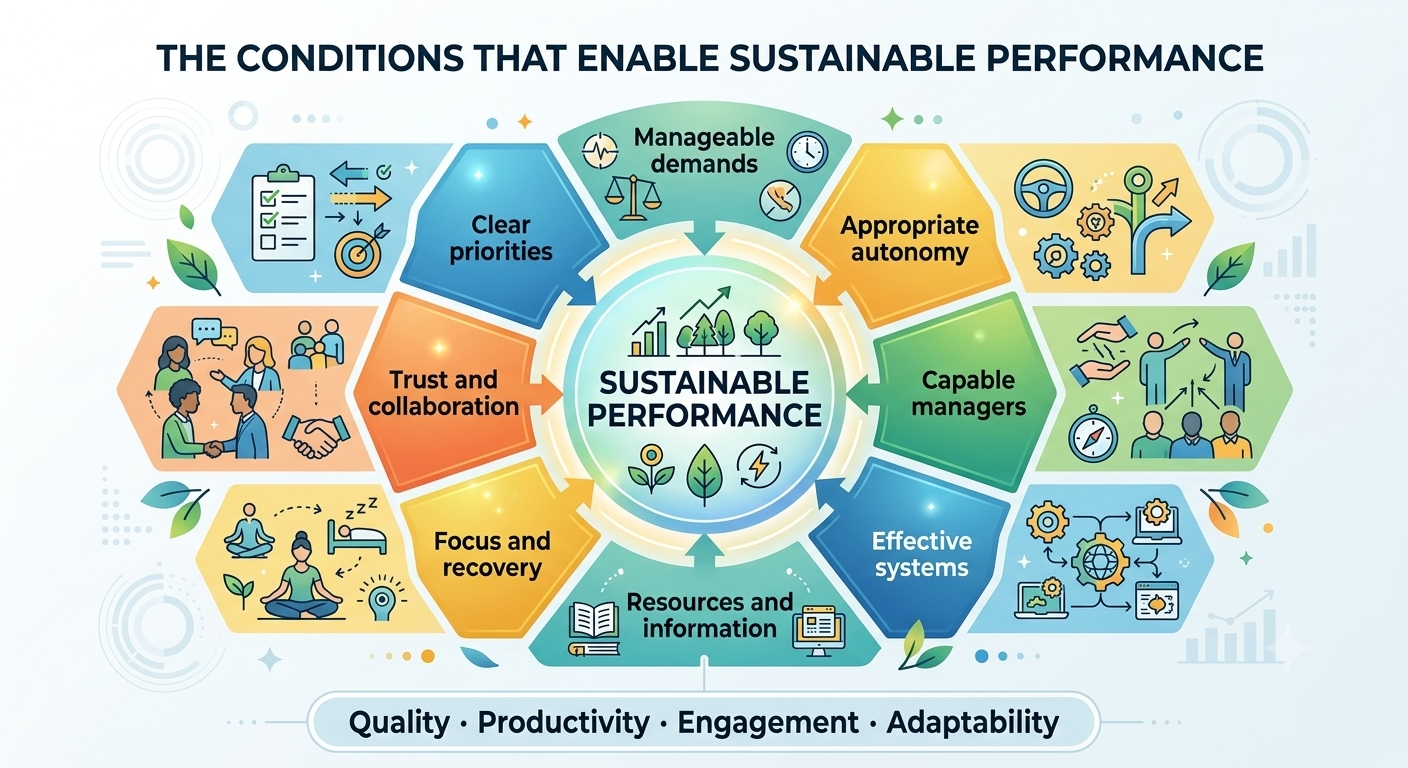
This is the role of work design. It considers how responsibilities, demands, resources, decision rights, relationships, systems, and working practices are combined to make performance possible.
Productivity is not the same as visible activity
Busy workplaces can create the appearance of strong performance.
Calendars are full, messages are answered quickly, meetings run throughout the day, and employees move constantly between tasks.
Yet activity does not automatically create value.
An employee may spend hours responding to internal requests without advancing their most important work. A manager may attend meetings all day and complete operational responsibilities at night. A team may generate extensive reports that few decision-makers use.
The organization remains active, but its attention becomes fragmented.
Productivity should therefore be understood as the effective conversion of time, capability, and resources into valuable outcomes.
That requires choices about what matters, what does not, and how work should be completed.
When organizations reward responsiveness, availability, and visible busyness more than thoughtful execution, employees adapt accordingly.
They attend meetings because absence may be interpreted as disengagement. They respond immediately because delay may be judged negatively. They accept additional tasks because saying no feels risky.
The result is a workplace in which everyone appears busy while important work competes continuously for attention.
A productive organization does not simply ask people to do more. It creates the conditions that help them accomplish what matters most.
Work design connects people with performance
Work design is important because it determines whether employees can translate their time, judgment, skills, and effort into valuable outcomes.
It includes more than job descriptions. It covers the practical experience of completing work, including:
- The amount and pace of work
- Clarity of responsibilities and priorities
- Access to information and resources
- Autonomy and decision-making authority
- Technology and processes
- Relationships and collaboration
- Manager support and feedback
- Opportunities for concentration and recovery
- How organizational change is managed
These factors interact.
Greater autonomy may improve performance, but not when expectations are unclear. Technology may save time, but not when several overlapping systems create duplication. Collaboration may strengthen decisions, but not when every decision requires a large meeting.
The UK Health and Safety Executive identifies demands, control, support, relationships, role, and change as six areas of work design that can affect health, productivity, absence, and workplace safety when they are not managed effectively. Review the HSE Management Standards.
This connection matters because the same conditions that influence employee health can also affect concentration, judgment, cooperation, quality, and delivery.
Good work design helps employees use their capability. Poor work design consumes it.
The work design problems that undermine productivity
Performance difficulties often emerge through several connected conditions rather than one visible failure.
Excessive workload
Workload includes volume, complexity, pace, emotional demands, interruptions, and the time available to complete work.
High demands are not automatically harmful. Many employees value challenging work and experience satisfaction from accomplishing difficult goals.
The problem arises when demands exceed available capacity for sustained periods.
Employees compensate by extending working hours, reducing breaks, working faster, or sacrificing attention to quality. Output may remain acceptable temporarily, which can conceal the pressure building underneath.
Over time, mistakes become more likely, collaboration declines, and employees focus on completing immediate tasks rather than improving how work is done.
HSE guidance states that organizations should provide demands that are adequate and achievable within agreed working hours, match work to people’s skills and abilities, and respond to concerns about the working environment. Read the HSE guidance on workplace demands.
A workload is not well designed simply because employees are still managing to deliver it.
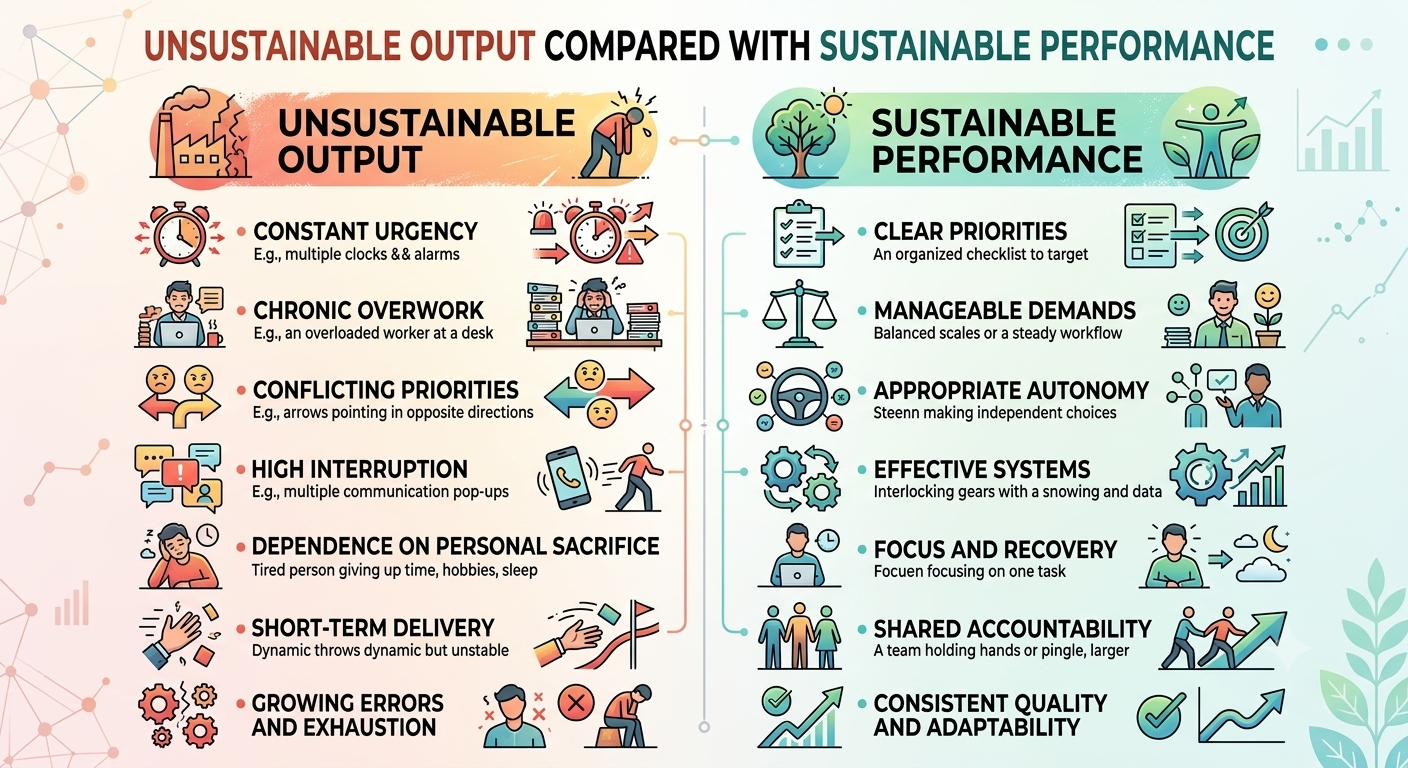
Leaders need to examine what performance currently depends on. When results require chronic overtime, missed breaks, unused leave, or continual personal sacrifice, the operating model is borrowing from future capacity.
Too many priorities
Organizations often struggle to distinguish between importance and urgency.
Every strategic initiative is described as essential. Every stakeholder request becomes a priority. Every deadline is presented as fixed.
Employees are then expected to resolve the competition between these demands themselves.
This creates a productivity problem because attention becomes divided across too many objectives. Work is repeatedly started, paused, resumed, and revised as priorities shift.
The issue is not always poor personal time management. It may be an absence of organizational choice.
Managers need to clarify which outcomes matter most, what order work should follow, and which activities can be stopped, delayed, simplified, or delegated.
Prioritization becomes credible only when choosing one priority changes what happens to the others.
Unclear roles and decision rights
Employees lose time when responsibilities overlap or authority is uncertain.
Several people may believe they own the same decision, while another task has no clear owner at all. Employees seek repeated approval because they do not know what they can decide independently.
Role ambiguity can also create conflict. People may be held accountable for outcomes while lacking authority over the resources or decisions required to achieve them.
HSE identifies role clarity as an important condition of healthy work. Its guidance emphasizes that employees should understand their responsibilities, receive clear requirements, and have a way to raise conflicting or uncertain expectations. Read the HSE guidance on role clarity.
Clear roles do not eliminate collaboration. They make collaboration more effective by clarifying ownership, contribution, and decision-making.
Limited autonomy
Employees are less able to perform when every action requires permission.
Excessive control slows decisions, discourages initiative, and places unnecessary pressure on managers.
It can also reduce learning because employees are given responsibility for execution without the opportunity to exercise judgment.
Appropriate autonomy allows people to decide how to organize tasks, respond to problems, and use their expertise within clear boundaries.
HSE’s standard on control emphasizes that employees should, where possible, have influence over their pace, work patterns, breaks, and the use of their skills and initiative. Read the HSE guidance on control.
Autonomy should be proportionate to experience, risk, and role. It does not mean removing oversight. It means allowing decisions to be made at the most appropriate level.
Responsibility without authority creates frustration. Authority without clarity creates risk. Sustainable performance requires an effective balance.
Ineffective systems and technology
Technology is frequently introduced with the promise of improving productivity.
It can automate repetitive work, improve access to information, and support faster collaboration. However, poorly integrated tools can create additional administration, duplication, interruptions, and confusion.
Employees may enter the same information into several systems, search across multiple platforms, or develop unofficial workarounds because formal processes do not reflect operational reality.
Artificial intelligence creates similar opportunities and risks.
It can support analysis, drafting, automation, and decision-making, but productivity will not improve simply because a new tool becomes available. Employees need clear use cases, appropriate training, reliable governance, and time to adapt their working practices.
Efficiency gains may also disappear when every saved hour is immediately filled with more work.
Technology improves performance when it removes friction from valuable work, not when it adds another layer that employees must manage.
Constant interruption
Many roles require communication and responsiveness, but continuous interruption makes concentration difficult.
Messages, notifications, unscheduled requests, and frequent meetings divide attention into increasingly small periods.
Employees may spend the day responding to other people’s priorities and begin focused work only after normal working hours.
Organizations sometimes respond by providing productivity training or focus tools. These may help, but they cannot solve a culture in which immediate availability is treated as a measure of commitment.
Teams need shared expectations about response times, meeting necessity, protected concentration, and which communication channels should be used for different levels of urgency.
Individual boundaries are easier to maintain when they are supported by collective working practices.
Inadequate resources and support
Performance depends on access to the resources required to complete the work.
These may include staffing, time, information, technology, training, budget, specialist expertise, and manager support.
When resources are insufficient, the shortfall is often transferred to employee effort.
People spend additional time searching for information, correcting preventable errors, covering vacant roles, or recreating work that already exists elsewhere.
HSE describes support as the encouragement, information, feedback, and resources provided by the organization, line management, and colleagues. Its guidance includes helping employees understand what support is available and how to access the resources needed to do their jobs. Read the HSE guidance on support.
Holding people accountable without providing the necessary conditions for success is not performance management. It is responsibility without organizational support.
Managers translate work design into daily experience
Managers influence how organizational demands are experienced locally.
They clarify priorities, allocate work, remove obstacles, provide feedback, and make decisions about flexibility and resources.
A capable manager can reduce unnecessary pressure by helping employees make trade-offs and identifying which work no longer adds value.
However, managers cannot repair every system themselves.
They may lack authority to adjust staffing, change technology, simplify approval processes, or challenge targets imposed from above.
Organizations should therefore avoid framing every productivity problem as a manager capability issue.
Managers need development, but they also need manageable spans of control, clear decision rights, realistic expectations, and senior support.
A capable manager can improve the experience of work, but they cannot compensate indefinitely for an operating model that remains badly designed.
Sustainable performance requires recovery
Recovery is sometimes treated as separate from productivity.
In reality, employees need opportunities to restore attention, energy, and judgment if performance is expected to continue.
This does not mean work should be free from pressure. It means intense effort should not become a permanent requirement.
Breaks, leave, predictable working patterns, variation in tasks, and periods of lower intensity help employees sustain performance.
Recovery also takes place during the working day. Employees benefit from enough space to reflect, learn, plan, and complete difficult tasks without constant interruption.
When every available moment is filled, the organization may achieve high short-term utilization while reducing its capacity for improvement and adaptation.
There is no room to examine recurring problems, strengthen processes, or develop new capability because all attention is committed to immediate delivery.
A system operating permanently at full capacity has little ability to absorb disruption, learn, or change.
Performance management cannot fix poor work design
Performance management is necessary when expectations are clear and an employee has the capability and resources to meet them but does not do so.
It becomes less effective when those conditions are absent.
An employee may miss deadlines because priorities change constantly. A team may produce inconsistent quality because staffing levels are insufficient. A manager may appear disorganized because their role combines operational delivery with responsibility for too many direct reports.
Treating these situations solely as individual performance failures can increase pressure without improving the system.
This does not remove personal accountability. Employees remain responsible for communicating concerns, using resources appropriately, developing capability, and meeting reasonable expectations.
The organization is responsible for ensuring those expectations are coherent and achievable.
Accountability works best when leaders can distinguish between unwillingness, inability, and work that has been made unnecessarily difficult.
Measure outcomes, not only effort
Organizations often measure the indicators that are easiest to observe.
They track hours, activity, responsiveness, attendance, completed tasks, and utilization.
These measures can be useful, but they may encourage behavior that appears productive without creating meaningful value.
A team can complete more tasks while customer outcomes decline. Employees can attend more meetings while decisions become slower. Working hours can increase while errors and rework consume the additional capacity.
A stronger performance approach examines:
- Quality and customer outcomes
- Completion of strategic priorities
- Time lost to rework and duplication
- Decision-making speed
- Workload sustainability
- Employee capacity and recovery
- Collaboration across teams
- Process friction and delays
- Ability to learn and adapt
- Risks to health, safety, and retention
The purpose is not to create an overwhelming dashboard. It is to select measures that reflect the outcomes the organization genuinely values.
Assess the system before adding another solution
When productivity concerns emerge, organizations often introduce a new tool, training program, reporting process, or performance initiative.
Each intervention may be reasonable, but adding more activity to a poorly understood system can increase complexity.
A structured assessment helps leaders understand how employees experience workload, autonomy, clarity, resources, management, communication, and organizational change.
It can reveal whether a performance problem is concentrated in one team, linked to a particular process, or repeated across the organization.
The evidence may show that employees need development. It may instead reveal that capable employees are being constrained by unclear decisions, fragmented systems, or competing demands.
HSE’s Management Standards approach recommends using organizational data, surveys, and employee discussion to identify underlying causes and develop practical improvements. Review the HSE Management Standards.
The objective is not simply to make employees more productive. It is to understand what currently helps or prevents productive work.
Work design also protects psychological health and safety
Performance and psychological health should not be treated as separate agendas.
The conditions that affect output can also create psychosocial risk.
Excessive demands, limited control, inadequate support, poor relationships, unclear roles, and badly managed change may affect both employee health and organizational performance.
The World Health Organization’s guidelines on mental health at work recommend organizational interventions that address working conditions, alongside manager training, employee training, individual support, and return-to-work programs.
ISO 45003 provides guidance for managing psychosocial risks within an occupational health and safety management system. It is intended to help organizations prevent work-related injury and ill health and promote wellbeing at work.
Dharma Centre for Workplace Wellbeing has been appointed by the British Standards Institution as a BSI Associate Consultant for ISO 45003.
This expertise informs Dharma’s approach to workplace performance, connecting productivity with healthy work design, psychological health and safety, and sustainable organizational capability.
Sustainable performance is designed, not demanded
High performance requires capable, motivated, and accountable people.
It also requires an environment that allows those people to use their capability effectively.
Organizations cannot remove every obstacle, prevent every demanding period, or design work that suits every individual preference.
They can create clearer priorities, improve decision rights, manage workload more responsibly, strengthen manager capability, simplify systems, and protect time for focused work and recovery.
They can also examine whether high output depends too heavily on employee sacrifice.
Organizations should therefore ask more than:
“How can we get people to perform better?”
They should also ask:
“How can we design work so that good performance becomes easier to achieve and more sustainable to maintain?”
That question changes performance improvement from an attempt to extract more individual effort into a disciplined examination of how the organization operates.
Create the conditions for sustainable performance
Dharma’s Workplace Performance Consultancy helps organizations understand the workplace conditions affecting productivity, quality, collaboration, employee capacity, and sustainable performance.
We help leaders identify barriers within workload, work design, management practices, organizational systems, and culture, then translate the evidence into focused and practical action.