Psychological Safety at Work: A Guide for Leaders
Aug 03, 2026
Psychological safety is not about making work comfortable or avoiding difficult conversations. It is about creating an environment in which people can speak honestly, raise concerns, admit mistakes, challenge assumptions, and contribute ideas without unreasonable fear of humiliation or retaliation.
By César Gamio, Founder and Managing Director · 9-minute read
Key takeaways
- Psychological safety helps organizations access information that employees might otherwise withhold.
- It must be combined with clarity, professional standards, respectful challenge, and accountability.
- Leaders should assess the workplace conditions shaping employee voice rather than relying on invitations to “speak up.”
Silence can look like alignment
A leadership team presents a new strategy and asks whether anyone has concerns.
The room remains quiet.
A manager proposes an aggressive deadline and receives no objections.
A project review ends without anyone mentioning the operational risk that several employees have discussed privately.
Leaders may interpret these moments as evidence of agreement, confidence, or commitment. Sometimes they are.
In other cases, employees have decided that speaking is not worth the risk.
They may believe that the decision has already been made, that challenge will be viewed as negativity, or that raising a problem will result in additional work without meaningful support.
They may have watched another employee speak honestly and suffer social, professional, or reputational consequences.
They may simply have learned that leaders ask for feedback more often than they act on it.
Silence does not always mean that people agree. It may mean they have stopped believing that honesty will help.
This is why psychological safety matters. It determines whether leaders receive the information they need to understand what is really happening inside the organization.
What psychological safety means
Psychological safety is often described as a shared belief that it is safe to take interpersonal risks within a team.
In practical terms, it influences whether employees feel able to:
- Ask questions when something is unclear
- Admit that they do not know
- Raise concerns about risk or quality
- Challenge a decision respectfully
- Offer an unconventional idea
- Acknowledge a mistake
- Request help
- Discuss workload or wellbeing
- Give upward feedback
- Disagree with someone more senior
These behaviors are essential in any organization that depends on learning, adaptation, innovation, quality, safety, or responsible decision-making.
Psychological safety does not mean that employees can say anything without consequence. It does not protect disrespectful behavior, weak performance, or a refusal to accept legitimate decisions.
It creates space for honest contribution within clear professional boundaries.
Psychological safety is not freedom from accountability. It is the confidence to participate honestly in the work.
Why psychological safety matters to performance
Organizations cannot respond effectively to information they never receive.
When employees withhold concerns, leaders may believe that a project is progressing well, that workloads are sustainable, or that a new process is working as intended.
The absence of challenge creates an incomplete picture.
Problems are often most visible to the people closest to the work. They may notice emerging client dissatisfaction, poor coordination, unrealistic deadlines, process failures, safety concerns, or unintended consequences long before senior leaders do.
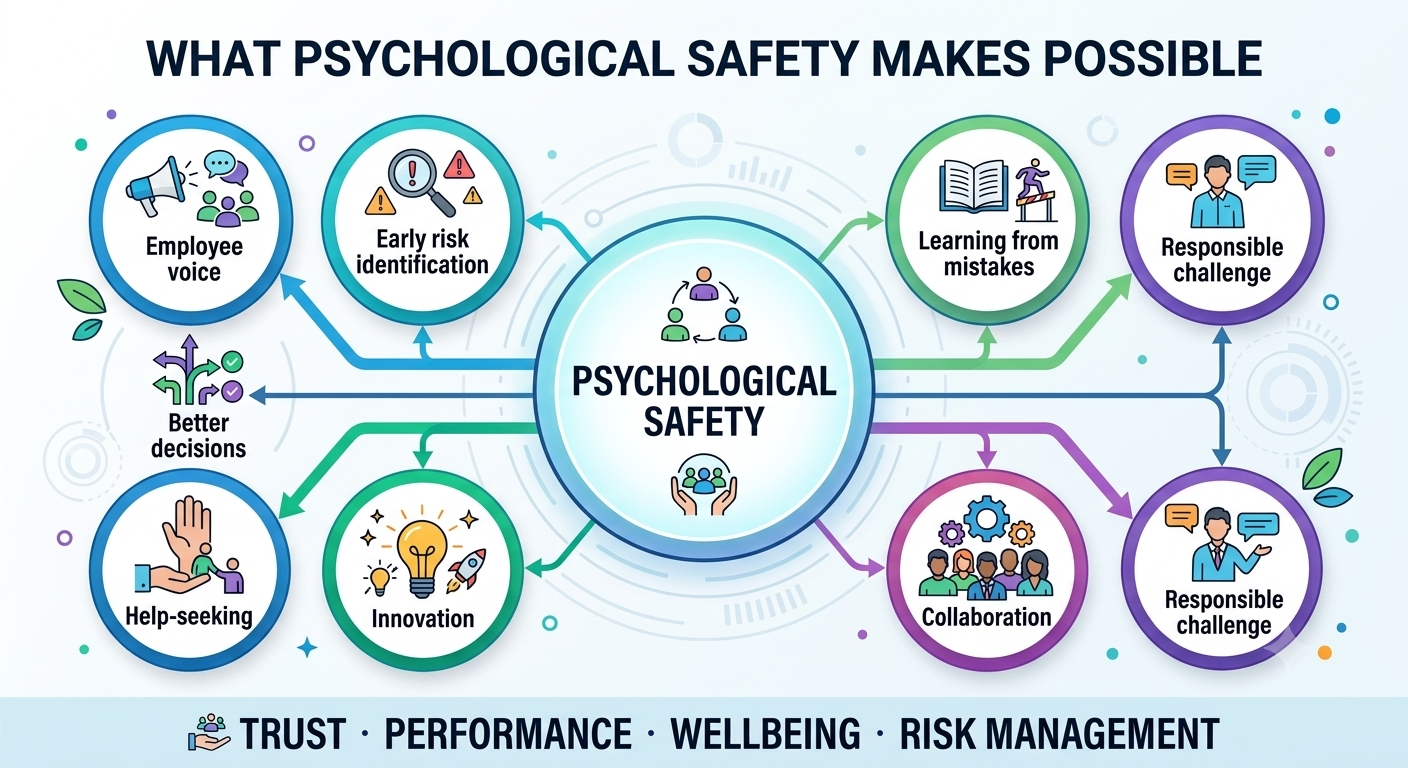
When those employees feel able to speak, the organization can respond earlier.
When they remain silent, leaders may only discover the issue after performance declines, a valuable employee leaves, a customer complains, or the risk becomes significantly more expensive to address.
Psychological safety also supports learning.
Employees are more likely to examine mistakes openly when they believe the purpose is to understand and improve rather than to assign blame. This allows teams to identify causes, strengthen systems, and reduce the likelihood of repetition.
A workplace that punishes honest information will eventually receive less of it.
Psychological safety is built through experience
Organizations sometimes attempt to create psychological safety by telling employees that their voices matter.
This may be a positive starting point, but employees are unlikely to judge safety from a presentation or company value.
They judge it from experience.
What happened the last time someone challenged a senior leader?
How did the manager respond when an employee admitted a mistake?
Were concerns explored, or dismissed as resistance?
Did the organization explain what happened after employees completed a survey?
Was a high performer allowed to behave in a way that would have been unacceptable from someone else?
Did the employee who raised a risk receive support, or become responsible for solving it alone?
Each experience provides evidence about whether speaking is genuinely safe and useful.
Employees believe what the organization repeatedly demonstrates, not simply what it declares.
The leadership behaviors that shape psychological safety
Managers and senior leaders have a significant influence on whether employees speak honestly.
Several leadership behaviors are particularly important.
Responding constructively to challenge
Leaders often say they welcome challenge, but the real test comes when that challenge is inconvenient.
An employee may question a favored proposal, identify an unrealistic deadline, or raise an issue the leader believed had already been resolved.
A defensive response can quickly close the conversation.
Leaders do not need to agree with every concern. They do need to show that the concern can be raised without personal consequences.
This involves listening, asking questions, separating the message from the person, and explaining the final decision.
A leader can reject a recommendation while still reinforcing that raising it was valuable.
Admitting uncertainty and mistakes
Leaders shape team norms through what they model.
When a manager pretends to know every answer, employees may conclude that uncertainty represents weakness.
When leaders acknowledge what they do not know, correct themselves, and explain what they learned from a mistake, they make honesty more legitimate for others.
This does not reduce leadership credibility. When done responsibly, it can strengthen trust by showing that accuracy and learning matter more than protecting an image of perfection.
Inviting specific contributions
General questions such as “Does anyone have any thoughts?” often produce little response.
Employees may not know what kind of input is genuinely useful, or whether the invitation is sincere.
More specific questions improve the quality of participation:
- What are we overlooking?
- Which assumption is least reliable?
- What could prevent this plan from succeeding?
- What concerns might employees be reluctant to raise?
- What would someone closest to the customer see differently?
- What evidence would cause us to reconsider?
These questions communicate that challenge is part of the work rather than an interruption to it.
Managing status and hierarchy
Employees are more likely to speak carefully when there is a significant difference in status, authority, expertise, or influence.
Leaders should not assume that an open-door policy removes this pressure.
The risk of speaking is experienced differently by a junior employee, a contractor, a new team member, or someone whose position already feels vulnerable.
Capable leaders create multiple ways for employees to contribute. These may include one-to-one conversations, structured meeting rounds, anonymous channels, surveys, facilitated discussions, and clear escalation processes.
The aim is not to remove hierarchy entirely. It is to prevent hierarchy from blocking information the organization needs.
Following through
Inviting feedback without visible action can weaken psychological safety.
Employees do not expect leaders to accept every suggestion or solve every problem immediately. They do expect clarity about what was heard and what will happen next.
Leaders should explain which issues will be addressed, which require further investigation, and which cannot currently change.
Honest follow-through is often more credible than vague reassurance.
Employee voice becomes meaningful when people can see a connection between speaking and organizational response.
Psychological safety and accountability must coexist
One of the most common misunderstandings is that psychological safety requires managers to lower standards or protect employees from discomfort.
That is not the case.
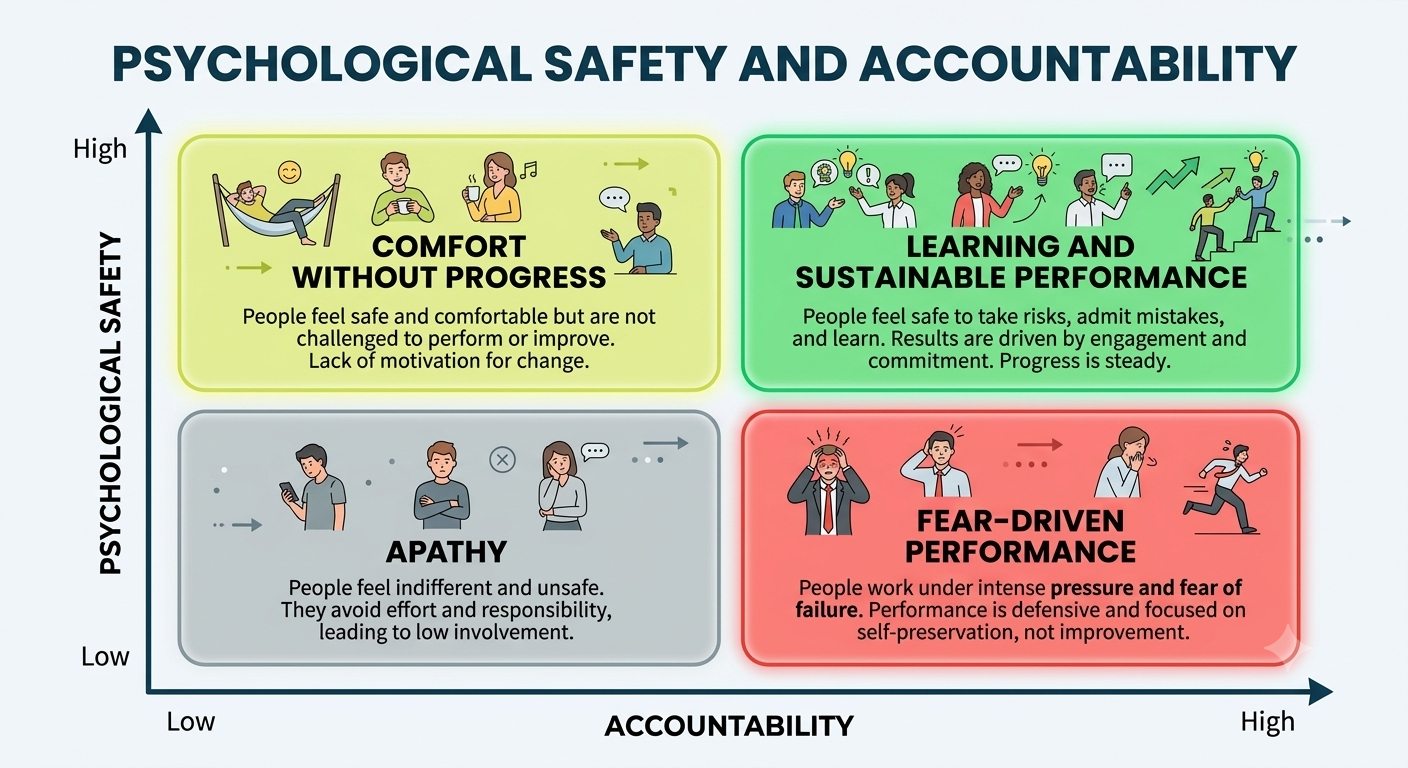
A psychologically safe team may still have demanding goals, direct feedback, performance concerns, difficult decisions, and serious disagreement.
The difference lies in how these are managed.
Employees should be able to discuss a missed target without being humiliated. They should be able to challenge a process while remaining responsible for following the final decision. They should be able to admit a mistake while still accepting appropriate consequences.
High psychological safety without accountability can create ambiguity and avoidance.
High accountability without psychological safety can create fear and concealment.
Strong teams need both.
Psychological safety allows the truth to enter the conversation. Accountability determines what happens next.
Common barriers to speaking up
Employees may remain silent for reasons that are not immediately visible to leaders.
Fear of negative consequences
Employees may worry that they will be viewed as difficult, disloyal, weak, or incapable.
This is particularly likely when concerns involve workload, mental health, misconduct, senior decisions, or a powerful colleague.
Even subtle consequences matter. Being excluded from future conversations, receiving fewer opportunities, or developing a reputation for negativity can be enough to discourage future honesty.
Previous feedback produced no change
Employees may have raised similar concerns before.
When nothing happened, they learned that speaking required effort without producing a useful result.
This is one reason repeated surveys can become counterproductive. The organization continues collecting information while employees see little evidence that the information changes decisions.
The concern is difficult to prove
Many emerging problems begin as patterns or intuitions rather than clear evidence.
An employee may sense that a client relationship is weakening, that workload is becoming unsafe, or that a team dynamic is deteriorating.
When leaders respond only to fully developed proof, employees may wait until the problem becomes undeniable.
Psychological safety allows concerns to be explored before certainty is available.
The person raising the issue becomes responsible for solving it
Employees may hesitate to identify a problem when they expect the response to be, “What are you going to do about it?”
Ownership is important, but responsibility should be proportionate to authority, resources, and role.
People should not be punished with additional work for identifying an organizational issue.
Inconsistent treatment
Employees notice whether standards apply equally.
When one person is praised for directness while another is criticized for the same behavior, psychological safety becomes dependent on status and relationships.
Consistency does not require identical responses in every situation. It does require transparent reasoning and fair standards.
Psychological safety is not simply a team issue
Psychological safety is often discussed at team level because local manager behavior has a powerful influence.
However, the wider organization also matters.
A manager may encourage openness while senior leaders punish challenge.
A team may discuss mistakes honestly while the performance system rewards individual certainty and competition.
Employees may be invited to raise workload concerns while organizational targets remain disconnected from available resources.
These contradictions limit what a capable manager can achieve.
Psychological safety is influenced by:
- Leadership behavior at every level
- Organizational culture
- Workload and staffing
- Performance and reward systems
- Communication practices
- Grievance and reporting processes
- Responses to mistakes
- Change management
- Fairness and inclusion
- Protection from bullying, harassment, and retaliation
Organizations should therefore avoid treating psychological safety as a communication technique or isolated leadership workshop.
It is a property of the working environment.
Psychological safety supports mental health and safety
Psychological safety and psychological health are related, but they are not identical.
Psychological safety concerns whether employees feel able to take interpersonal risks, such as asking for help, admitting uncertainty, or raising a concern.
Psychological health and safety concerns the broader management of workplace conditions that may contribute to psychological harm.
The two interact.
Employees are less likely to discuss excessive workload, bullying, role conflict, poor support, or harmful change when they fear the consequences of speaking.
This makes psychological safety an important source of risk information.
ISO 45003 provides guidance for managing psychological health and safety risks within an occupational health and safety management system. It emphasizes consultation, worker participation, leadership, communication, and the identification of psychosocial hazards.
Dharma Centre for Workplace Wellbeing has been appointed by the British Standards Institution as a BSI Associate Consultant for ISO 45003.
This expertise informs Dharma’s approach to psychological safety, helping organizations examine both employee voice and the workplace conditions that influence whether people can speak honestly.
Why training alone is not enough
Psychological safety training can help leaders understand the concept and practice useful behaviors.
However, training cannot overcome an environment that continues to reward silence.
A manager may learn to invite challenge, but employees will remain cautious if senior leaders respond badly to unwelcome information.
Employees may attend speaking-up workshops while believing that formal reporting processes are ineffective or unsafe.
Organizations need to examine the system around the behavior.
This includes whether managers have time to listen, whether concerns are documented and followed through, whether confidentiality is protected appropriately, and whether employees trust the available escalation routes.
Psychological safety improves when leadership behavior, organizational systems, and employee experience reinforce the same message.
Assess before assuming
Leaders often overestimate the level of psychological safety in their teams.
They may point to friendly relationships, active meetings, low grievance numbers, or an open-door policy.
None of these provides enough evidence on its own.
Employees may contribute freely to low-risk discussions while withholding concerns about leadership, workload, behavior, or strategic decisions.
A structured Psychological Safety Assessment can help identify:
- Whether employees feel able to speak honestly
- Which topics feel most difficult to raise
- How managers respond to challenge and mistakes
- Whether employees believe concerns lead to action
- Differences between teams, levels, and locations
- The organizational conditions reinforcing silence
- Priority areas for leadership and cultural improvement
Assessment should then lead to dialogue and action.
The goal is not to produce a score for its own sake. It is to understand what employees are currently learning about the consequences of honesty.
Building psychological safety in practice
Organizations can begin by strengthening a small number of consistent practices.
Leaders should model curiosity, particularly when information is unwelcome. Managers should ask specific questions, acknowledge their own uncertainty, and explain decisions transparently.
Teams should establish clear expectations for respectful disagreement, feedback, mistakes, and escalation.
Organizations should provide several safe channels for employee voice and make responsibilities for follow-through visible.
Managers should receive development in listening, feedback, conflict, accountability, and wellbeing conversations.
Senior leaders should also examine whether workload, incentives, hierarchy, or inconsistent consequences are making silence rational.
Psychological safety develops through repeated experiences. Each constructive response strengthens trust. Each defensive or punitive response can weaken it.
Better decisions begin with more honest information
Psychological safety is not an abstract cultural benefit.
It affects whether leaders receive accurate information, whether teams learn from mistakes, whether risks are identified early, and whether employees can contribute their knowledge fully.
It also affects trust.
Employees do not need every suggestion to be accepted. They need to know that responsible honesty will be treated fairly.
Organizations should therefore ask more than:
“Have we told employees that they can speak up?”
They should also ask:
“What happens here when someone says something we would rather not hear?”
The answer reveals far more about psychological safety than any statement of intent.
Understand whether employees feel safe to speak
Dharma’s Psychological Safety Assessment helps organizations understand whether employees feel able to raise concerns, challenge assumptions, acknowledge mistakes, and contribute honestly.
It identifies the leadership behaviors and workplace conditions influencing employee voice, helping leaders prioritize practical action that strengthens trust, learning, risk awareness, and performance.