Manager Capability: What Today’s Workplace Demands
Aug 03, 2026
Managers are expected to deliver performance, support employee wellbeing, navigate change, build trust, manage conflict, develop talent, and translate strategy into action. Yet many organizations still promote people into management without adequately preparing them for the complexity of the role.
By César Gamio, Founder and Managing Director · 9-minute read
Key takeaways
- Manager capability now extends far beyond task supervision and technical expertise.
- Managers shape employees’ experience of workload, trust, accountability, psychological safety, change, and performance.
- Organizations need to diagnose capability gaps and provide sustained development rather than relying on isolated training.
The manager role has become more demanding
The manager role has changed significantly.
Managers are still expected to allocate work, monitor delivery, solve problems, and maintain standards. They must now do this while leading hybrid teams, adapting to new technology, managing organizational change, supporting employee wellbeing, and responding to increasingly complex expectations about leadership behavior.
They are often expected to coach rather than direct, empower rather than control, and create psychological safety while maintaining clear accountability.
Many also carry significant operational workloads of their own.
Despite this, organizations frequently continue to treat management as a natural extension of technical expertise. A strong specialist or high performer is promoted and expected to learn the human side of leadership through experience.
Some succeed. Many struggle silently.
Being good at the work does not automatically prepare someone to lead the people doing it.
Managing performance, relationships, behavior, uncertainty, and human motivation requires a distinct set of capabilities. These capabilities can be developed, but they should never be assumed.
Employees experience the organization through their manager
Employees may join an organization because of its reputation, purpose, benefits, or career opportunities.
Their daily experience, however, is shaped heavily by their immediate manager.
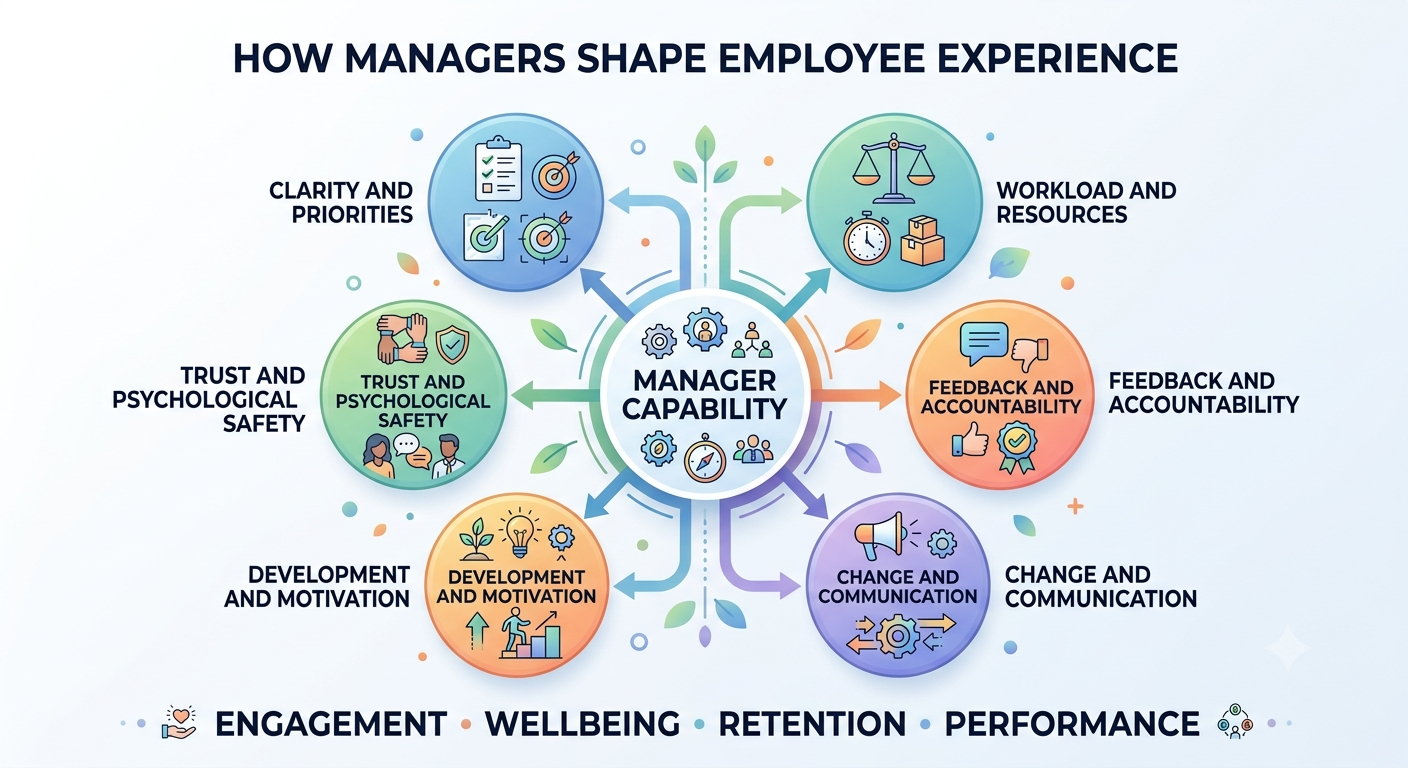
Managers influence how priorities are explained, how workloads are allocated, how mistakes are handled, how achievements are recognized, and whether employee concerns are treated seriously.
They determine whether accountability feels constructive, whether flexibility feels fair, and whether employees receive the clarity and support required to perform.
Gallup reports that managers account for a significant proportion of the variation in team engagement. This does not mean managers are solely responsible for employee experience, but it demonstrates how strongly local leadership influences whether people feel clear, supported, valued, and connected to their work. Explore Gallup’s research on leadership, engagement, and culture.
Managers may not control strategy, pay structures, staffing budgets, or commercial pressures. They do influence how those realities are translated into everyday work.
A difficult decision can be communicated with clarity and respect, or delivered with ambiguity and avoidance. A period of high demand can be managed through prioritization and support, or treated as pressure employees are expected to absorb personally.
Managers do not control every workplace condition, but they often determine how those conditions are experienced.
Why technical expertise is not enough
Technical credibility matters. Managers need enough understanding of the work to make informed decisions, evaluate quality, allocate resources, and support their teams.
The problem arises when technical competence is treated as the main qualification for leadership.
A highly capable specialist may still find it difficult to delegate, provide feedback, manage conflict, or hold someone accountable without damaging the relationship.
They may continue solving every problem themselves because that is where they feel most confident. Over time, they become a bottleneck, restrict the development of others, and increase their own workload.
This often gets misdiagnosed as a time management problem. The deeper issue may be a lack of confidence in delegation, coaching, expectation setting, or performance conversations.
The transition into management requires a change in professional identity, not simply a longer list of responsibilities.
A manager’s value no longer comes only from the work they personally complete. It increasingly comes from the conditions they create for other people to succeed.
The capabilities managers need today
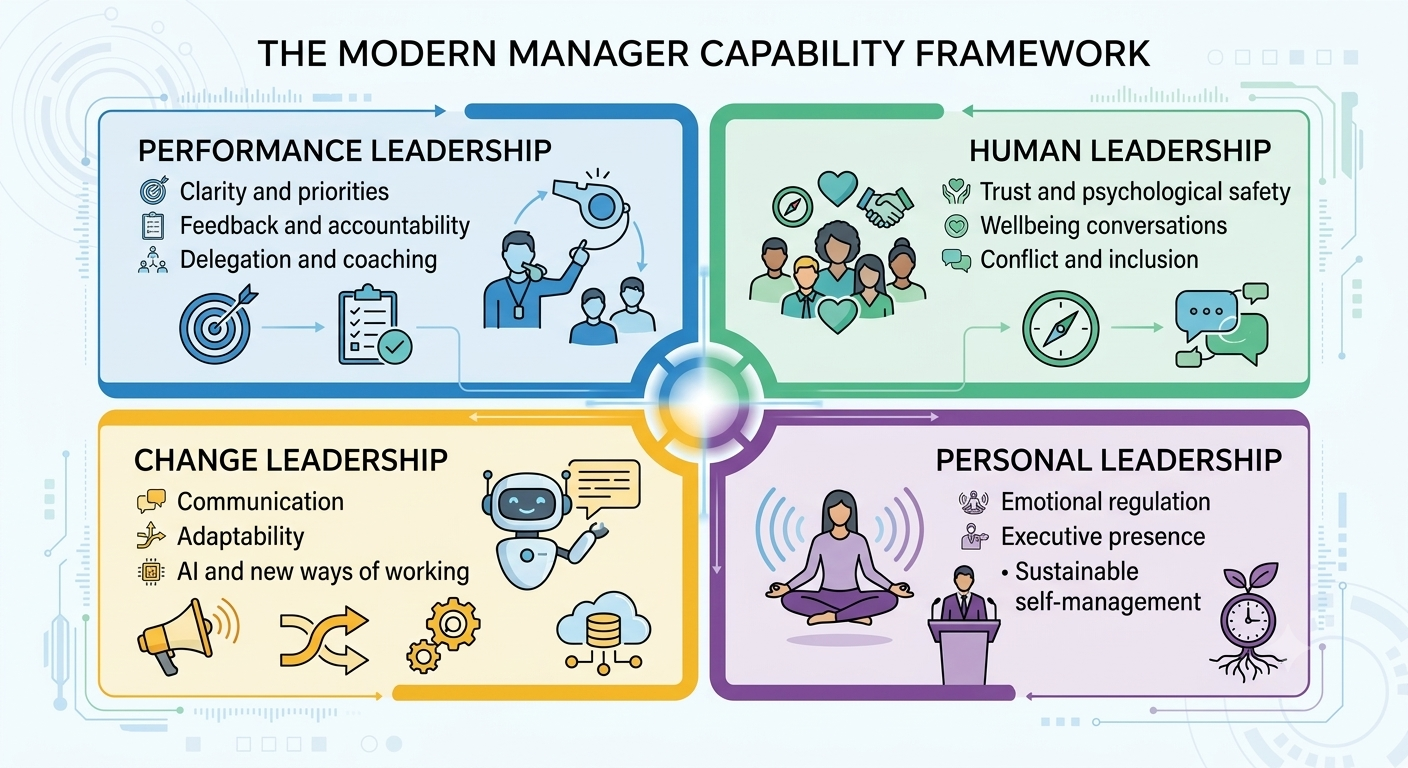
Different organizations require different leadership styles, but several capabilities have become essential across most workplaces.
Setting clarity and direction
Employees need to understand what matters, what good performance looks like, and how competing priorities should be handled.
Managers often assume expectations are clearer than they really are. They may communicate a task without explaining its purpose, urgency, quality standard, or relationship to other work.
Clarity does not mean controlling every detail. It means creating enough shared understanding for employees to make sound decisions independently.
The UK Health and Safety Executive identifies role clarity as one of the areas of work design that can contribute to work-related stress when poorly managed. Employees should understand their responsibilities and know how to raise uncertainty or conflicting demands. Review the HSE Management Standards.
People cannot be held fairly accountable for expectations that were never made clear.
Managing workload and priorities
Managers sit at the point where organizational ambition meets available capacity.
They may receive several urgent requests from senior leaders, clients, or other functions and pass them directly to the team without resolving the conflict between them.
This leaves employees with more priorities than time.
Capable workload management requires an understanding of volume, complexity, emotional demands, interruptions, resources, and deadlines. Managers also need to distinguish between temporary pressure and an unsustainable operating pattern.
Most importantly, they must make trade-offs.
When new work is introduced, managers should ask what will be delayed, stopped, simplified, delegated, or resourced differently.
Prioritization is not telling employees that everything is important. It is deciding what matters most.
Giving effective feedback
Feedback is one of the most common management responsibilities and one of the most inconsistently performed.
Some managers avoid it until a formal review or until frustration has accumulated. Others provide frequent criticism without enough clarity or context.
Effective feedback should help employees understand what happened, why it matters, and what should happen next.
It should be timely enough to be useful and specific enough to support action. This applies to positive feedback as well as corrective feedback.
Managers also need to receive feedback without becoming defensive. Employees quickly learn whether honesty is genuinely welcomed or merely requested.
The quality of feedback shapes both performance and trust.
Holding people accountable constructively
Accountability is not the opposite of empathy or psychological safety.
Healthy accountability gives employees clear expectations, appropriate support, timely feedback, and fair consequences.
Weak accountability allows performance and behavior issues to continue until frustration spreads through the team. Punitive accountability creates a different problem, because employees become more concerned with avoiding blame than solving problems.
Capable managers address issues early. They distinguish between a capability gap, a resource problem, unclear expectations, a conduct issue, and a reasonable mistake.
Accountability becomes constructive when it combines clarity, fairness, support, and consequence.
Coaching, delegation, and development
Managers are not expected to become professional coaches, but they do need basic coaching capability.
This means resisting the urge to provide every answer, asking questions that strengthen thinking, and helping employees take greater ownership of decisions.
Without this skill, managers can create dependency. Team members escalate every decision, and the manager becomes overloaded by work that others could increasingly handle.
Effective delegation also requires clarity about outcomes, authority, resources, boundaries, and points of review.
Managers often under-delegate because completing the work themselves feels faster. That may be true in the short term, but repeated under-delegation limits capability and makes the team dependent on one person.
Delegation develops capability only when people are given enough ownership to think, decide, and learn.
Managing difficult conversations and conflict
Managers frequently encounter underperformance, behavior concerns, interpersonal tension, resistance to change, and emotionally charged situations.
Avoiding these conversations rarely makes them disappear.
Unresolved tension becomes part of the team’s working environment. Employees may spend time interpreting silence, forming alliances, or protecting themselves.
Capable managers prepare carefully, describe concerns clearly, listen, and remain focused on resolution.
Conflict is not always harmful. Responsible disagreement can improve decisions, expose risk, and challenge weak assumptions.
The manager’s role is to create conditions in which disagreement remains productive rather than personal or unsafe.
Building psychological safety and trust
Psychological safety is not created by telling employees they can speak openly.
It develops when managers repeatedly respond constructively to questions, mistakes, concerns, and disagreement.
Employees observe what happens when someone admits uncertainty, identifies a risk, or challenges an established view.
When the response is curiosity and respect, trust can grow. When the response is embarrassment, dismissal, or retaliation, silence becomes rational.
Psychological safety does not remove performance expectations. It enables employees to share the information required to meet them.
A team cannot manage risks it is afraid to discuss.
Supporting wellbeing without becoming a clinician
Managers have an important role in employee wellbeing, but that role needs clear boundaries.
They are not expected to diagnose mental health conditions or provide therapy.
They should be able to notice meaningful changes, begin a respectful conversation, listen without making assumptions, consider whether work is contributing to the problem, and direct employees toward appropriate support.
The World Health Organization’s guidelines on mental health at work recommend manager training that helps managers recognize and respond to emotional distress, strengthen communication, and understand how workplace stressors affect mental health.
Managers also need organizational support. They require clear processes, specialist resources, and the authority to address workload, role clarity, flexibility, relationships, and access to resources.
A manager should know how to open the door to support without being expected to provide all of it.
Leading through change and new technology
Managers often communicate change that they did not design and may not fully understand.
Employees nevertheless turn to them for explanation, reassurance, and direction.
Capable managers distinguish between uncertainty and silence. They communicate what is known, acknowledge what is not yet known, explain the rationale where possible, and create space for employees to process the implications.
Artificial intelligence has added another layer of complexity.
Managers must help employees adopt new tools while protecting judgment, accountability, trust, and meaningful human contribution. They may also need to address uncertainty about job security, capability, fairness, monitoring, and the future value of particular roles.
Faster technology does not automatically create sustainable work. Productivity gains can disappear when every efficiency is immediately converted into additional demand.
The manager’s role is not simply to introduce new technology. It is to help people use it responsibly, confidently, and purposefully.
One-off management training is rarely enough
Organizations often respond to capability gaps by commissioning a workshop.
A focused session can introduce useful ideas, create common language, and allow managers to practice specific skills.
The problem is expecting one event to create sustained behavioral change.
Managers return to environments shaped by workload, habits, senior leadership behavior, performance systems, and competing priorities. Without reinforcement, learning can quickly disappear beneath operational pressure.
Development is stronger when it includes:
- A clear definition of the capabilities the organization needs
- Diagnosis of current strengths and gaps
- Practical learning connected to real situations
- Opportunities to practice and reflect
- Senior leadership support
- Peer learning and accountability
- Follow-up resources
- Measurement of behavioral change
Manager development should also be differentiated. A first-time manager may need help with delegation, confidence, feedback, and professional identity. An experienced leader may need to strengthen strategic influence, change leadership, or performance under complexity.
The objective is not to complete management training. It is to improve how management is practiced.
Managers need the right conditions too
Managers are employees who may also be dealing with excessive workloads, limited autonomy, unclear priorities, difficult senior relationships, and constant change.
They are often expected to protect their teams from pressure while receiving that same pressure from above.
Training managers to communicate better will not fully resolve a system that gives them neither the time nor the authority to act differently.
Organizations need to examine managers’ spans of control, operational responsibilities, decision rights, resources, and access to support.
Organizations cannot strengthen manager capability while ignoring the conditions in which managers are expected to lead.
Capability should be diagnosed before it is developed
Leadership development is often selected based on topics that appear popular or urgent.
An organization may commission coaching skills because managers are too directive, psychological safety training because employees are not speaking up, or resilience training because managers are exhausted.
Each intervention may be useful, but the visible problem does not always reveal the underlying capability gap.
Low psychological safety may be connected to defensiveness, inconsistent accountability, weak listening, or senior leaders who punish challenge.
Poor delegation may arise from a lack of trust, unclear roles, fear of losing control, or performance systems that reward individual contribution more than team development.
A structured diagnostic helps distinguish between these possibilities.
It shows where managers are already strong, where capability is inconsistent, and which gaps are most likely to affect performance, trust, wellbeing, and retention.
Without diagnosis, organizations often measure attendance, satisfaction, and course completion rather than whether management behavior has actually improved.
Manager capability is an organizational system
Organizations should avoid placing the entire burden of leadership improvement on individual managers.
Capability is influenced by recruitment, promotion, expectations, development, senior role modeling, performance management, incentives, and work design.
A manager may be trained to empower employees while senior leaders continue to centralize every decision. They may be encouraged to protect wellbeing while being rewarded for output regardless of the human cost.
These contradictions reduce the credibility of development.
A stronger system defines what good management looks like, assesses it, develops it, reinforces it, and holds leaders accountable for it.
ISO 45003 provides guidance for managing psychological health and safety risks associated with factors such as leadership, work organization, communication, support, and organizational culture.
Dharma Centre for Workplace Wellbeing has been appointed by the British Standards Institution as a BSI Associate Consultant for ISO 45003.
This expertise informs Dharma’s approach to leadership development, helping organizations connect manager capability with psychological health, safety, wellbeing, and sustainable performance.
Better managers create better conditions for performance
Managers do not need to be perfect.
They do need the awareness, capability, and support to lead people responsibly.
A capable manager creates clarity without controlling every detail. They set standards while remaining open to challenge. They support wellbeing without avoiding accountability. They develop others without neglecting delivery.
Every response to a mistake, concern, missed deadline, new idea, or difficult question teaches employees something about what is safe, valued, and expected.
Organizations should therefore ask more than:
“Have our managers completed leadership training?”
They should also ask:
“Do our managers have the capability and organizational support to create the conditions in which people can perform?”
The answer shapes culture, engagement, retention, wellbeing, trust, and the organization’s ability to deliver its strategy.
Identify the leadership capabilities that matter most
Dharma’s complimentary Leadership Excellence Diagnostic helps leaders identify their current strengths, development priorities, and the capabilities most relevant to leading effectively in today’s workplace.
The diagnostic takes approximately six minutes and provides immediate personalized insights and practical recommendations.