Employee Wellbeing: What Actually Improves It at Work
Aug 03, 2026
Employee wellbeing is not created by benefits, apps, or isolated initiatives alone. It is shaped by the conditions in which people work, including workload, leadership behavior, trust, autonomy, fairness, support, and work design.
By César Gamio, Founder and Managing Director · 9-minute read
Key takeaways
- Wellbeing initiatives work best when they complement healthy workplace conditions rather than compensate for unhealthy ones.
- Workload, autonomy, manager behavior, psychological safety, role clarity, fairness, and organizational change all influence employee wellbeing.
- Organizations need to measure the conditions affecting wellbeing and connect their findings to visible, prioritized action.
Employee wellbeing has become a crowded agenda
Employee wellbeing now appears in almost every organization’s people strategy.
Employers offer wellbeing apps, mental health resources, resilience workshops, employee assistance programs, flexible benefits, financial education, fitness support, and awareness campaigns.
Many of these initiatives provide genuine value. They can increase access to support, reduce stigma, help employees develop useful skills, and demonstrate that the organization is willing to invest in its people.
However, the growing number of wellbeing activities has also created a strategic problem. Organizations can become highly active without becoming more effective.
A company may offer meditation sessions while employees continue working through unsustainable workloads. It may provide resilience training while managers remain inconsistent or unsupportive. It may promote work life balance while rewarding long hours and constant availability.
The wellbeing program may appear comprehensive, yet the everyday experience of work remains unchanged.
The number of wellbeing initiatives an organization offers does not necessarily reveal how healthy the workplace is.
This is why employee wellbeing needs to be understood as an organizational outcome, not simply as a collection of services.
Employee wellbeing is shaped through work
Wellbeing is often treated as something employees bring to work from their personal lives.
Personal health, family circumstances, finances, relationships, habits, and access to healthcare clearly matter. Employers cannot control every factor influencing how an employee feels.
However, work also affects wellbeing.
The World Health Organization’s guidance on mental health at work recognizes that decent work can support mental health by providing livelihood, purpose, confidence, relationships, and a sense of achievement. It also identifies risks associated with poor working environments, including excessive workloads, low job control, discrimination, inequality, and job insecurity.
This distinction changes the organization’s role.
The employer is not responsible for managing every aspect of an employee’s life. It is responsible for understanding and managing the conditions it creates through work.
Those conditions include how demands are set, how decisions are made, how managers behave, how change is communicated, and whether employees have the resources, support, and control required to perform effectively.
Employee wellbeing is partly personal, but workplace wellbeing is always organizational.
Why wellbeing programs often underperform
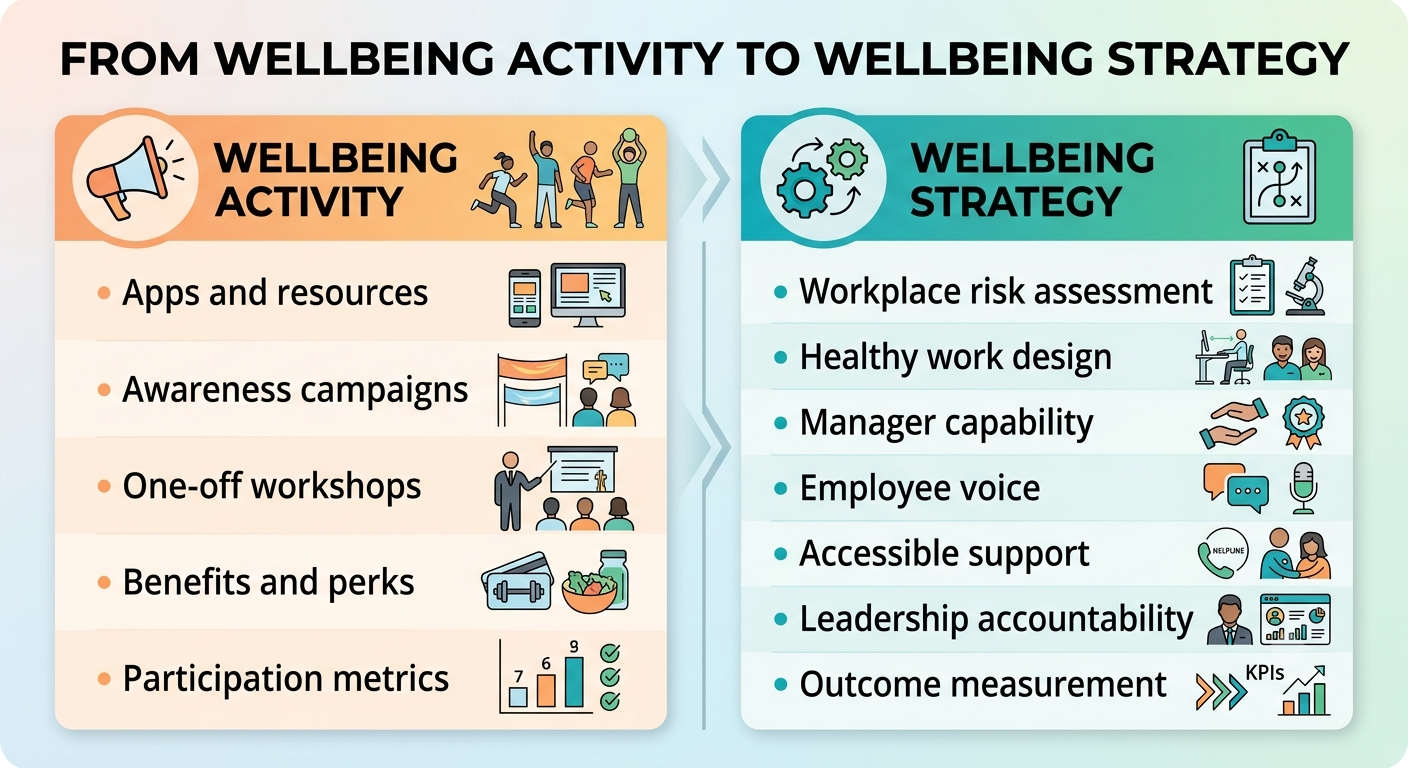
Wellbeing programs frequently underperform because they focus on support after strain has already developed.
Employees may be given access to counseling, coaching, mindfulness, exercise, or resilience resources. These services can help individuals manage difficult circumstances, but they may not reduce the source of the difficulty.
The organization introduces an initiative, measures participation, and collects positive feedback from those who use it. Leaders may then conclude that the wellbeing strategy is working.
Meanwhile, the conditions driving stress, exhaustion, disengagement, or poor mental health remain largely unchanged.
There may still be excessive workloads, conflicting priorities, poor manager behavior, limited control, unclear roles, inadequate staffing, weak psychological safety, poorly managed change, or inconsistent flexibility.
The initiative may help employees cope with these conditions, but it does not necessarily improve them.
Support is valuable, but support should not become a substitute for prevention.
The WHO guidelines on mental health at work recommend organizational interventions alongside manager training, worker training, individual support, return to work programs, and action for people living with mental health conditions.
This layered approach matters because it combines support for individuals with changes to the working environment.
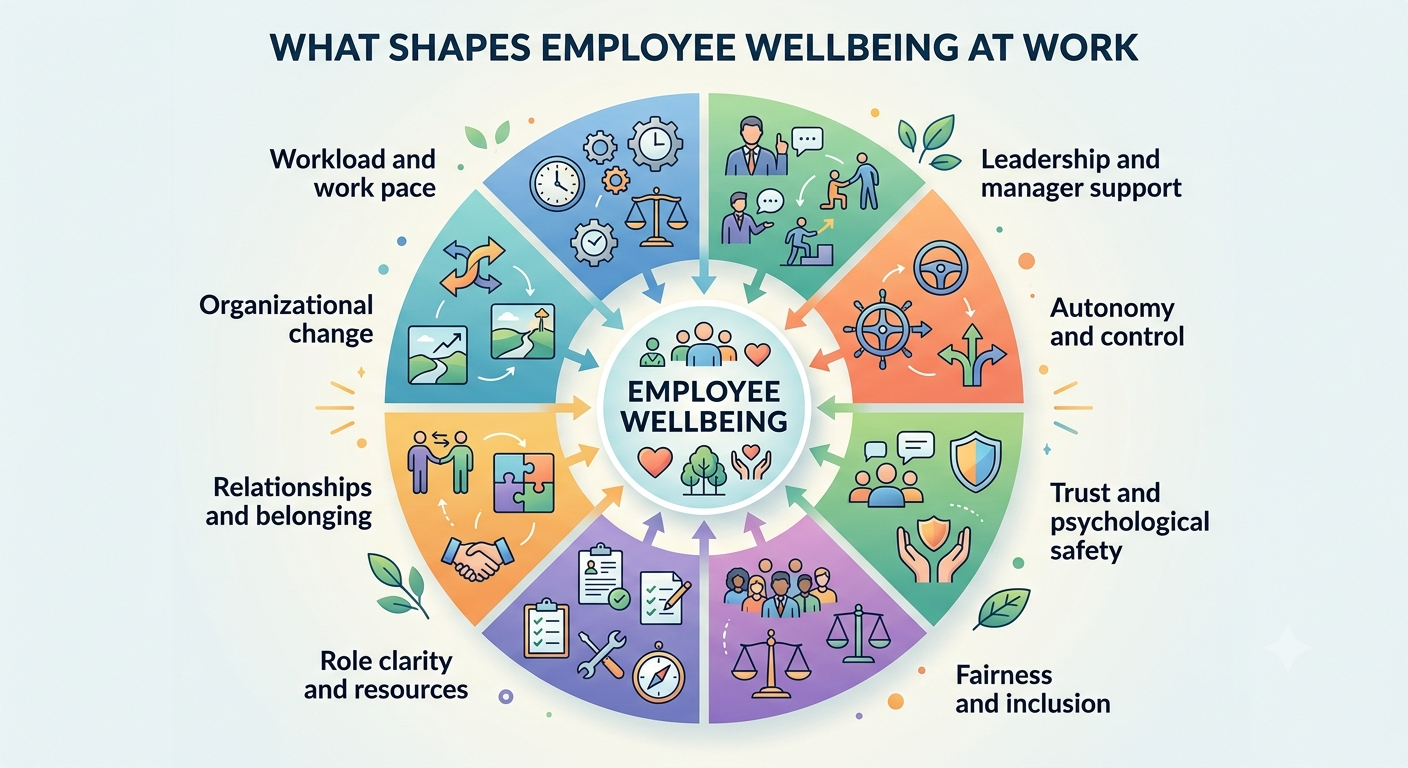
The conditions that influence employee wellbeing
Employee wellbeing is shaped by many interacting factors, but several workplace conditions deserve particular attention.
Workload and work pace
Workload is not simply the amount of work assigned to an employee. It includes pace, complexity, emotional demands, time pressure, interruptions, staffing levels, and opportunities for recovery.
A demanding role can be engaging and rewarding when expectations are achievable, priorities are clear, and employees have appropriate resources.
The same role can become harmful when high demands are continuous, conflicting, or impossible to complete within reasonable working patterns.
Employees often compensate by working longer hours, skipping breaks, postponing recovery, or lowering the quality of attention they give to each task.
This compensation can conceal the problem because output remains acceptable for a period.
A workload is not sustainable simply because employees have not yet failed to deliver it.
Autonomy and control
People generally cope better with demanding work when they have an appropriate level of control over how it is completed.
Autonomy may include influence over scheduling, task order, working methods, decision-making, and how employees respond to changing circumstances.
Too little control can create frustration and helplessness. Too much responsibility without the authority or resources to act can be equally damaging.
The UK Health and Safety Executive identifies control as one of six areas of work design that can contribute to work-related stress when it is not managed properly. The others are demands, support, relationships, role, and change. Review the HSE guidance on work-related stress.
Control does not mean allowing employees to ignore standards. It means giving them enough influence to use their judgment, organize their work, and respond effectively.
Leadership and manager behavior
Employees experience organizational wellbeing largely through their managers.
Managers influence how work is allocated, whether expectations are clear, how concerns are received, how conflict is managed, and whether flexibility is handled fairly.
A manager does not need to act as a counselor or clinician. They do need the capability to recognize when an employee may be struggling, hold a supportive conversation, consider reasonable adjustments, signpost professional help, and examine whether work itself is contributing to the problem.
Manager training is therefore relevant, but training alone is not enough.
Managers also need manageable spans of control, clear responsibilities, senior support, and the authority to address the problems employees raise.
An organization cannot expect managers to support wellbeing while placing them inside the same unhealthy conditions they are being asked to manage.
Psychological safety and employee voice
Employee wellbeing is affected by whether people feel able to speak honestly.
Employees need to be able to raise concerns about workload, mistakes, misconduct, uncertainty, health, and risk without fearing humiliation, retaliation, or career damage.
When psychological safety is low, employees may remain silent until the situation becomes serious. They may hide mistakes, avoid asking for help, withdraw from discussion, or continue working despite exhaustion because admitting difficulty feels unsafe.
A culture of silence can make the organization appear healthier than it is.
Survey scores may look acceptable, absence may remain low, and employees may continue delivering. However, these indicators do not reveal what people are withholding.
Silence should never be mistaken for wellbeing.
Role clarity, resources, and fairness
Employees struggle when they do not understand what is expected, how priorities should be balanced, or who has authority to make a decision.
Unclear roles create duplication, conflict, delay, and anxiety. Employees may work harder while achieving less because time is spent resolving ambiguity rather than completing meaningful work.
Resources matter as well. Employees need appropriate staffing, information, technology, time, training, and support.
Wellbeing declines when employees are repeatedly held accountable for outcomes without being given the conditions required to achieve them.
Fairness is equally influential.
Employees notice how flexibility is allocated, how opportunities are offered, how workloads are distributed, and whether senior or high-performing individuals are held to the same behavioral standards as everyone else.
Fairness does not require identical treatment in every situation. It requires consistency, transparency, and a credible rationale.
Relationships, belonging, and change
Work can provide connection, identity, shared purpose, and mutual support.
Positive relationships can reduce some of the pressure employees experience, while isolation, conflict, bullying, or exclusion can intensify it.
Belonging is not created through social events alone. It develops when employees feel respected, included in relevant conversations, able to contribute, and connected to meaningful work.
Organizational change can also affect wellbeing, even when the change itself is necessary.
Employees adapt more effectively when leaders explain why change is happening, communicate what is known, acknowledge uncertainty, and provide appropriate opportunities for involvement.
Poorly managed change creates ambiguity, rumor, loss of control, and fatigue.
Change becomes more damaging when employees are expected to absorb uncertainty without context, influence, or support.
Wellbeing is broader than mental health
Employee wellbeing includes mental health, but it is not limited to it.
A credible strategy considers the wider experience of work, including physical health, emotional wellbeing, relationships, financial concerns, inclusion, development, and the ability to recover.
The CIPD’s health and wellbeing at work research describes wellbeing as a holistic organizational agenda and highlights the continuing effects of work on both mental and physical health.
This does not mean organizations need a separate initiative for every dimension of wellbeing. It means they need a coherent strategy that recognizes how those dimensions interact.
Financial strain may affect concentration and sleep, but the employee’s experience will also depend on pay fairness, job security, manager sensitivity, and access to support.
Physical health may be influenced by occupational hazards, ergonomics, workload, shift design, and recovery.
Social wellbeing may be affected by team relationships, inclusion, remote working practices, and leadership behavior.
A holistic strategy does not attempt to control employees’ lives. It considers whether organizational decisions support or undermine their ability to remain healthy and effective.
Why resilience is not the complete answer
Resilience enables people to adapt, recover, and continue functioning during difficulty.
It is a valuable capability, and organizations can support employees through training, coaching, recovery opportunities, and access to professional resources.
However, resilience should not be used to shift responsibility for unhealthy working conditions onto employees.
An employee may become better at managing stress, setting boundaries, or regulating emotions. That does not make an impossible workload achievable, an abusive manager acceptable, or a confusing role clear.
The goal is not to create employees who can tolerate any workplace condition. The goal is to create conditions in which resilience can be used constructively.
Wellbeing and performance are connected
Organizations sometimes treat employee wellbeing and performance as competing priorities.
This creates a false choice.
Healthy workplaces still require accountability, effort, challenge, change, and high standards. Wellbeing does not mean removing all pressure or protecting employees from every difficult experience.
It means designing work so that performance does not depend on chronic overload, fear, confusion, or sacrifice.
When employees have clarity, support, trust, resources, and appropriate control, they are better positioned to concentrate, collaborate, solve problems, and adapt.
When these conditions are absent, more energy is spent managing the environment. Employees become preoccupied with unclear expectations, excessive demands, internal politics, or self-protection.
ISO 45003 provides guidance for managing risks to psychological health and safety within an occupational health and safety management system. It supports a structured approach to preventing harm and promoting wellbeing at work.
Sustainable performance does not require organizations to choose between results and wellbeing. It requires them to understand how the conditions of work influence both.
Measuring wellbeing requires more than participation data
Organizations often measure wellbeing through participation in programs.
They may track the number of employees using an app, attending a webinar, accessing counseling, or completing a wellbeing challenge.
These figures provide information about activity, but they do not reveal whether the workplace is becoming healthier.
High use of support services may indicate that employees value them. It may also indicate that large numbers of employees are struggling.
Low use may mean that employees do not need the service, but it could also reflect lack of awareness, confidentiality concerns, poor accessibility, or cultural stigma.
Organizations therefore need a broader evidence base that may include:
- Employee perceptions of workload and control
- Psychological safety and trust
- Manager support
- Absence and turnover patterns
- Working hours and unused leave
- Role clarity and access to resources
- Qualitative feedback
- Workplace and psychosocial risk assessments
The purpose is not to create one universal wellbeing score. It is to understand which conditions are helping employees thrive, which are creating harm, and where the organization has the greatest ability to intervene.
From isolated initiatives to an integrated strategy
Organizations can strengthen their approach by following a more disciplined sequence.
First, define what employee wellbeing means in the context of the organization. The definition should connect health, employee experience, safety, and sustainable performance.
Second, assess current workplace conditions rather than relying on assumptions. This requires employee voice, organizational data, and structured assessment.
Third, identify priority risks and opportunities. Not every issue can be addressed at once, so leaders need to focus on the conditions creating the greatest impact.
Fourth, combine prevention with support. Employees need access to resources when difficulties arise, while the organization also works to reduce avoidable causes.
Fifth, strengthen manager capability. Managers need practical skills, clear responsibilities, and support from senior leadership.
Finally, establish ownership and communicate progress. Actions should have named owners, realistic timelines, and indicators showing whether conditions are improving.
Wellbeing cannot be owned by one team when the conditions influencing it are created across the whole organization.
Employee wellbeing improves when work improves
Benefits, apps, training, and support services can all contribute to employee wellbeing.
The problem arises when organizations ask these interventions to carry responsibility for workplace conditions they were never designed to fix.
A wellbeing app cannot create a fair workload. A resilience workshop cannot make a difficult manager more capable. An employee assistance program cannot repair a culture in which people are afraid to speak.
These services matter, but they sit within a larger system.
Employee wellbeing improves when people can do meaningful work under conditions that are clear, fair, supportive, and sustainable. It improves when managers are capable, employee voice is valued, and harmful conditions are addressed rather than normalized.
Organizations should therefore ask more than:
“What wellbeing initiatives should we offer?”
They should also ask:
“What is the experience of working here doing to our people?”
The answer provides a much stronger foundation for an effective wellbeing strategy.
Understand what is shaping employee wellbeing
Dharma’s Workplace Wellbeing Assessment helps organizations understand the workplace conditions influencing employee mental health, engagement, trust, performance, and sustainable wellbeing.
It provides evidence about employee experience, helps leaders identify priority areas for action, and supports a more integrated approach to workplace wellbeing.