Burnout at Work: Why Resilience Is Not Enough
Aug 03, 2026
Burnout is often treated as an individual resilience problem. Yet when exhaustion, cynicism, and reduced effectiveness are being driven by workload, limited control, poor support, or unhealthy working practices, helping employees cope more effectively will not address the underlying cause.
By César Gamio, Founder and Managing Director · 9-minute read
Key takeaways
- Burnout develops in relation to chronic workplace stress that has not been successfully managed.
- Resilience training and individual support can help, but they cannot compensate for persistently unhealthy working conditions.
- Organizations need to identify and manage the workplace risks contributing to burnout, while providing support and recovery opportunities for employees.
Burnout rarely begins with a dramatic collapse
Burnout is often recognized late.
An employee takes extended leave, resigns unexpectedly, becomes visibly disengaged, or tells their manager that they can no longer continue.
By this stage, the organization may view the situation as sudden.
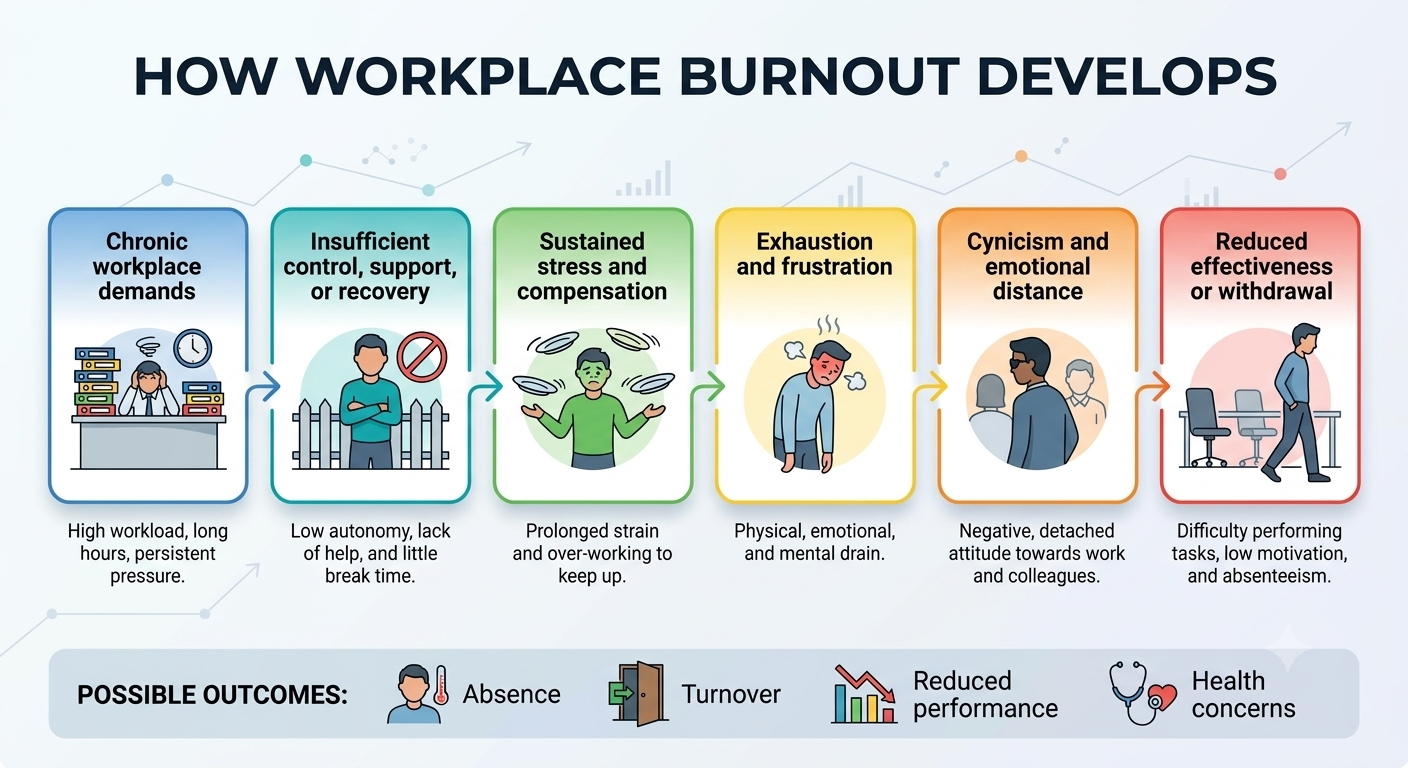
In reality, burnout often develops gradually.
A capable employee begins working longer to keep pace with growing demands. They respond to messages outside normal working hours, postpone leave, and accept additional responsibilities because they care about the quality of their work.
Their performance may remain strong for a considerable period.
This can make the situation difficult to detect. Leaders see delivery, reliability, and commitment. They may not see the increasing effort required to maintain them.
Over time, energy declines. Frustration becomes cynicism. Concentration becomes harder. Work that once felt meaningful begins to feel emotionally distant or impossible to influence.
Burnout can remain hidden while an employee is still producing good work.
This is why organizations should not wait for visible breakdown, absence, or resignation before examining whether working conditions are sustainable.
What burnout means
The World Health Organization includes burnout in the International Classification of Diseases as an occupational phenomenon, not as a medical condition. It describes burnout as resulting from chronic workplace stress that has not been successfully managed and identifies three dimensions: exhaustion, increased mental distance or cynicism toward work, and reduced professional effectiveness.
This definition matters for two reasons.
First, burnout relates specifically to the occupational context. People may experience exhaustion or distress for many reasons, but burnout concerns the relationship between the person and work.
Second, the definition directs attention toward chronic workplace stress that has not been managed successfully.
That does not mean every case has a single organizational cause. Personal circumstances, health, caring responsibilities, and individual differences may influence how someone responds to pressure.
However, describing burnout only as a personal weakness or lack of resilience misses the role of working conditions.
Burnout is experienced by individuals, but its causes may be embedded in the way work is organized and managed.
Why resilience has become the default response
Resilience is valuable.
It can help people regulate emotions, maintain perspective, recover from setbacks, establish boundaries, and respond more constructively during periods of difficulty.
These capabilities matter in every workplace because work will never be free from pressure, disappointment, uncertainty, or change.
The problem arises when resilience becomes the organization’s main response to conditions it has the power to improve.
Employees may be invited to attend resilience workshops while excessive workload continues. They may be taught breathing techniques while remaining available across several time zones. They may receive advice about boundaries while managers reward immediate responses outside working hours.
The intervention asks employees to become better at tolerating an environment that remains unchanged.
This can create a subtle transfer of responsibility.
The organization provides the resource, while the employee becomes responsible for whether they can continue coping.
Resilience should help employees navigate unavoidable pressure. It should not be used to normalize avoidable harm.
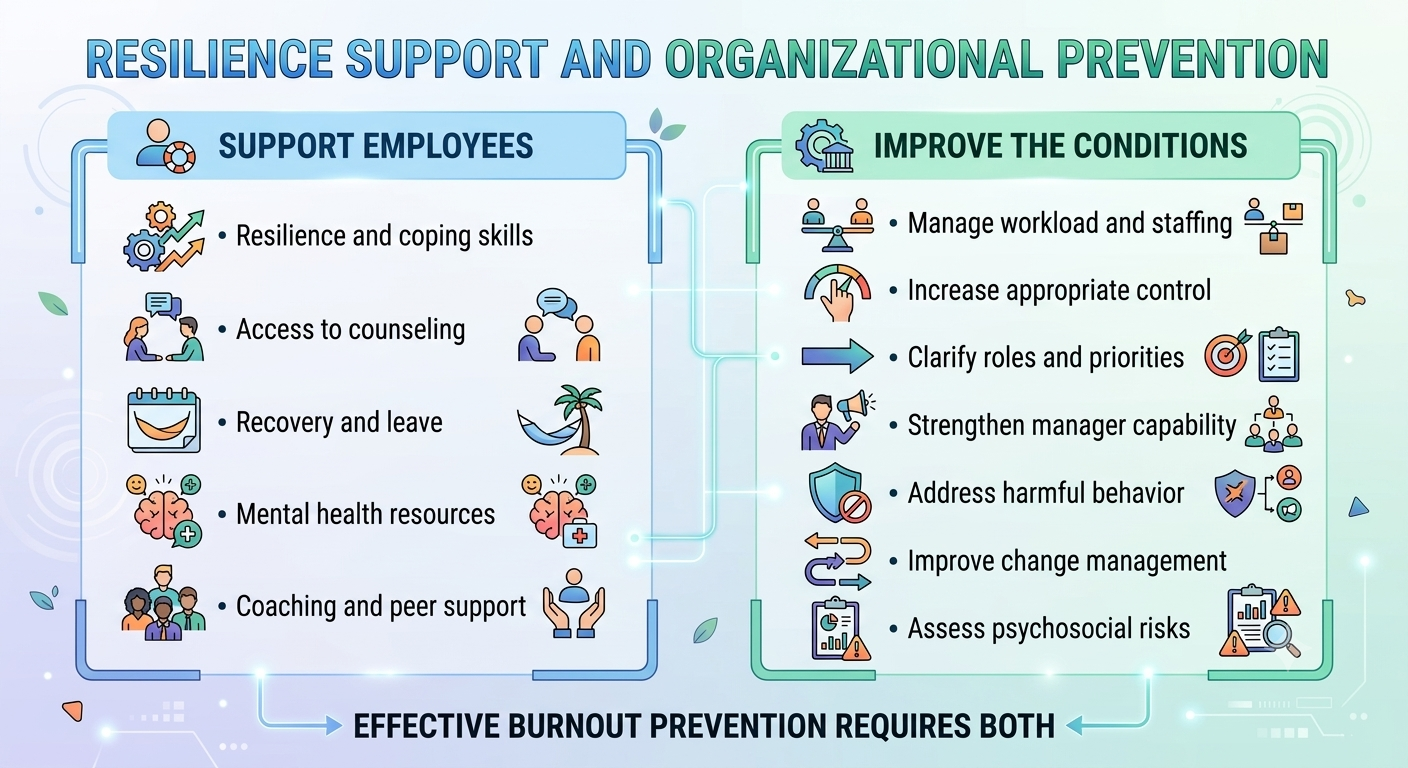
The World Health Organization’s guidance recommends organizational interventions that address working conditions, alongside manager training, worker training, individual support, return to work programs, and support for people living with mental health conditions.
The important word is alongside.
Individual support and organizational prevention are complementary. Neither should be asked to replace the other.
The workplace conditions that contribute to burnout
Burnout rarely results from workload alone. It is often shaped by several interacting workplace conditions.
Excessive and unrelenting demands
Periods of high demand are part of working life.
A product launch, major transaction, emergency, regulatory deadline, or operational disruption may require exceptional effort for a limited period.
The greater risk arises when exceptional pressure becomes the normal operating model.
Employees may face continuous high volume, emotional demands, frequent interruptions, understaffing, unrealistic deadlines, or competing priorities.
The absence of recovery is particularly important.
People can often manage demanding periods when they are followed by rest, recognition, learning, and a return to more sustainable expectations.
When each demanding period is followed immediately by another, the organization begins spending human capacity faster than it can be restored.
Pressure becomes more harmful when it is continuous, unpredictable, and disconnected from meaningful recovery.
Limited control and autonomy
Employees are more likely to struggle when they have substantial responsibility but little influence over how work is completed.
They may be accountable for results while being unable to change deadlines, staffing, processes, or priorities.
They may need approval for minor decisions, yet remain responsible when delays occur.
This combination of high demand and low control can create frustration and helplessness.
Autonomy does not mean removing standards or oversight. It means giving employees an appropriate level of influence over work methods, scheduling, decisions, and problem-solving.
The UK Health and Safety Executive identifies demands and control among six areas of work design that should be managed to reduce work-related stress. The remaining areas are support, relationships, role, and organizational change.
Conflicting priorities and unclear roles
Burnout risk increases when employees cannot determine what matters most.
They may receive urgent requests from several stakeholders, each of whom assumes their work takes priority.
The employee is left to manage the conflict personally.
Instead of making a clear organizational choice, leaders ask the employee to deliver everything.
Role ambiguity creates a similar problem. Employees may be unclear about responsibilities, decision rights, quality expectations, or where one person’s role ends and another begins.
This creates duplicated effort, avoidable conflict, delay, and anxiety.
A long task list is difficult. A long task list with no credible priorities is far more damaging.
Managers should not simply communicate more work. They need to help employees make trade-offs and clarify what will be delayed, stopped, simplified, delegated, or resourced differently.
Inadequate support
Support includes practical resources, emotional encouragement, access to information, constructive feedback, and help when problems arise.
Employees may feel unsupported when managers are unavailable, colleagues are overloaded, or organizational systems make it difficult to obtain assistance.
Support also depends on how leaders respond when someone says they are struggling.
A manager may listen sympathetically but take no action on workload or priorities. The employee feels heard, but the condition remains unchanged.
Another manager may respond by questioning the employee’s competence or commitment. The employee learns to conceal future difficulty.
Support becomes credible when concern is followed by appropriate action.
Poor relationships and harmful behavior
Conflict, bullying, harassment, exclusion, incivility, and inconsistent treatment consume emotional energy.
Employees may spend considerable effort anticipating how someone will react, preparing to defend themselves, or avoiding interactions that feel unsafe.
The effect can extend beyond those directly involved.
Team members who observe harmful behavior without an appropriate organizational response learn that the behavior may be tolerated.
This weakens trust and increases self-protection.
A high performer who creates fear or instability should not be treated as a net organizational asset simply because their individual output is strong. The wider cost may appear through silence, turnover, reduced collaboration, and burnout in others.
Poorly managed change
Change creates additional cognitive and emotional demands.
Employees need to understand what is changing, why it is changing, what remains uncertain, and how their responsibilities will be affected.
When communication is delayed or vague, employees fill the gap with speculation.
When several changes overlap, people may be expected to learn new systems, maintain existing performance, support colleagues, and adapt to uncertainty simultaneously.
The HSE includes change among its six core areas for managing work-related stress, reflecting the importance of how organizational change is communicated and managed.
Change fatigue is not necessarily resistance to progress. It may reflect a workplace that has underestimated the human capacity required to absorb repeated transition.
Why the most committed employees may be vulnerable
Burnout is sometimes associated with employees who lack coping skills or cannot manage pressure.
In practice, highly committed employees can be particularly vulnerable.
They care about the outcome. They do not want to disappoint colleagues, clients, patients, customers, or leaders. They may take pride in being dependable and capable.
This commitment encourages them to compensate when systems fail.
They work later, absorb unclear responsibilities, solve problems outside their role, and protect others from the consequences of understaffing or poor planning.
Because they continue delivering, the organization may not recognize the extent of the problem.
It may even reward the behavior.
The employee is praised for always being available, handling every crisis, or going beyond expectations. The praise reinforces a pattern that is gradually becoming unsustainable.
Commitment can conceal burnout risk when organizations repeatedly rely on personal sacrifice to make the system work.
Organizations should examine where strong performance depends on repeated heroic effort. What appears to be exceptional dedication may also be evidence that work is poorly designed or inadequately resourced.
Managers play a critical role, but cannot solve burnout alone
Managers influence workload, clarity, support, flexibility, recognition, and whether employees feel able to discuss strain.
They should be able to notice changes in behavior, initiate respectful conversations, listen carefully, and consider whether work is contributing to the problem.
They also need to understand their boundaries. Managers are not expected to diagnose burnout or provide clinical treatment.
Their role is to open a constructive conversation, address the factors they can influence, and connect employees with appropriate professional or organizational support.
However, organizations should avoid making managers individually responsible for risks created by senior decisions.
A manager cannot resolve chronic understaffing without budget authority. They cannot protect recovery when executive communication expects constant availability. They cannot create role clarity when the organizational structure remains unresolved.
Managers need the authority, resources, and senior backing to act on what employees tell them.
Manager capability matters, but capable managers cannot compensate indefinitely for unhealthy organizational systems.
Burnout prevention requires a risk-management approach
Many organizations address burnout after employees begin showing signs of difficulty.
A stronger approach identifies workplace risks before harm becomes visible.
This requires organizations to examine patterns in workload, working hours, absence, turnover, employee feedback, management practices, role clarity, change, relationships, and access to support.
Employee surveys may contribute useful evidence, but generic engagement questions are not always sufficient.
Employees can remain engaged with the purpose of their work while also becoming exhausted by the way it is organized.
Organizations need to ask more directly about demands, control, support, psychological safety, relationships, role clarity, and change.
HSE’s Management Standards approach centers on these six areas of work design and encourages organizations to assess risk and take action rather than treating stress only as an individual health issue.
ISO 45003 provides guidance for managing psychosocial risks within an occupational health and safety management system. It is intended to help organizations prevent work-related injury and ill health while promoting wellbeing, and it applies across organizational sizes and sectors.
Dharma Centre for Workplace Wellbeing has been appointed by the British Standards Institution as a BSI Associate Consultant for ISO 45003.
This expertise informs Dharma’s approach to burnout prevention by connecting employee experience with structured psychological health and safety risk management.
Recovery needs organizational permission
Recovery cannot depend entirely on an employee’s ability to protect personal time.
Organizations influence recovery through workloads, staffing, leave practices, meeting culture, technology, manager behavior, and expectations about availability.
A policy may encourage employees to disconnect, but the lived expectation may be different.
Employees notice who responds late at night, who receives recognition, how quickly leaders expect answers, and whether taking leave creates an unmanageable backlog.
Recovery also needs to occur during work, not only after it.
Reasonable breaks, variation in tasks, opportunities to reflect, supportive relationships, and periods of lower intensity can all help employees sustain performance.
Time away from work is important, but a holiday should not function as emergency maintenance for a permanently overloaded system.
Employees cannot recover effectively when the conditions exhausting them remain unchanged and are waiting for them when they return.
From burnout response to burnout prevention
Organizations can strengthen their approach through a clear sequence.
First, define burnout accurately and avoid using the term as a general label for every form of stress, dissatisfaction, or fatigue.
Second, assess the working conditions that may be contributing to chronic pressure. This should include employee voice, organizational data, and structured risk assessment.
Third, identify priority areas. These may involve workload, control, manager capability, role clarity, relationships, resources, or change.
Fourth, combine prevention with support. Employees need accessible resources and appropriate adjustments, while the organization works on the causes it can influence.
Fifth, assign clear ownership. Burnout prevention cannot sit solely with HR or a wellbeing team because the relevant conditions are often created through operations, finance, staffing, technology, and senior leadership decisions.
Finally, measure whether conditions are improving. Participation in a resilience workshop is not evidence that burnout risk has reduced.
The stronger question is whether employees are experiencing more manageable demands, greater clarity, better support, healthier working patterns, and increased confidence that concerns will lead to action.
Resilience is part of the solution, not the whole solution
Resilience deserves a place in a credible workplace strategy.
Employees benefit from skills that help them adapt, recover, communicate boundaries, and manage difficult situations.
Managers benefit from the confidence to hold supportive conversations and respond constructively to signs of strain.
Organizations benefit when people can navigate change and pressure without losing perspective or effectiveness.
However, resilience cannot transform an impossible workload into a sustainable one. It cannot compensate for unclear priorities, inadequate staffing, harmful leadership, or a culture of permanent availability.
Burnout prevention becomes credible when organizations stop asking only:
“How can we help employees cope better?”
They also need to ask:
“What are employees being required to cope with, and which of those conditions can we change?”
That question moves burnout from an individual weakness narrative toward responsible workplace management.
Identify the workplace risks contributing to burnout
Dharma’s Psychosocial Risk Assessment helps organizations identify the workplace conditions that may be contributing to chronic stress, exhaustion, disengagement, and burnout.
It provides leaders with evidence across areas such as demands, control, support, relationships, role clarity, organizational change, leadership, and workplace culture, helping them prioritize practical action and demonstrate a structured approach to psychological health and safety.